

Gaspard LEZIN
10 Best Side Businesses to Start in 2026
Looking for the best side businesses to start? Explore our list of 10 high-potential ideas with realistic revenue, startup costs, and expert tips for 2026.
You want extra income, but not another hobby that drains your nights and weekends. You want something you can start without renting office space, ordering inventory, or waiting months to see whether anyone will pay. That's why the best side businesses to start in 2026 are mostly digital, skill-based, or community-driven.
Starting small is easier now because the internet removed a lot of the old friction. You can sell a template, offer a freelance service, run a paid community, invoice a client overseas, or launch a niche store without building a full company on day one. You can also reach buyers outside your home market, which matters because side businesses often grow faster once you stop thinking locally.
This guide keeps it practical. You'll find 10 strong options, what makes each one work, where people usually get stuck, and the first steps that move the business forward. Where reliable figures exist, they're included. Where they don't, the advice stays qualitative. You'll also see where modern payment setup matters, especially if you're selling globally and want customers to pay by card or crypto while you receive funds the way you choose.
Table of Contents
Pick a narrow problem first
Start with one service and one buyer
Consistency matters more than format
The business lives or dies on margins
Sell outcomes, not vague advice
Trust is the whole model
Memberships need structure
Don't build the course in a vacuum
Productize before you hire
Productize before you scale
Top 10 Side Businesses Comparison
Take Your First Step Today
1. Digital Product Sales and Downloads
Digital products are one of the cleanest side businesses because you build once and can sell repeatedly. Good examples include Notion templates, Excel tools, Figma assets, e-books, niche mini-courses, or downloadable resources for a specific profession.
The mistake is trying to sell “useful” products to everyone. A better move is to build for a narrow buyer with an obvious problem, like a client onboarding kit for freelancers, a budgeting template for creators, or a content calendar pack for a podcast producer.
Pick a narrow problem first
A lot of side-hustle advice points toward digital products because they scale without physical inventory. Salesforce's side hustle ideas overview specifically highlights niche plug-and-play templates for platforms like Notion and Excel, and also points to landing page bounce rates and ad click-through rates as useful early signals for testing demand.
That's the right mindset. Don't spend weeks polishing before validation. Put up a simple sales page, show screenshots, explain the result, and offer a free sample.
Solve one job well: Build a product that helps someone finish one task faster.
Protect access: If you sell downloads, communities, or courses, use gated delivery so buyers get access after payment.
Reduce checkout friction: Global buyers won't all want to pay the same way.
If you sell internationally, payment setup starts to matter earlier than most creators expect. Suby gives businesses an API to accept payments by card or crypto, and it also offers native Discord and Telegram integrations for subscriptions, paid access, and online communities. Customers pay any way they want, businesses get paid the way they choose. For a practical breakdown, see how to sell digital products online.
Practical rule: If people can't describe your product in one sentence, it's probably too broad.
2. Freelance Services (Writing, Design, Development)

Freelancing is still one of the best side businesses to start because it monetizes skills you already have. Writing, design, development, SEO, video editing, and virtual assistance all fit, especially if you can tie your work to a clear business result.
The scale is real. Side Hustle Nation reports that nearly 64 million Americans, about 39% of the U.S. workforce, are freelancing, generating over $1.3 trillion in annual revenue. The same source also notes that freelancing is one of the most popular and best side businesses to start, often with startup costs under $1,000.
Start with one service and one buyer
Generalists get ignored. Specialists get hired. “I write blog posts for B2B SaaS teams” is stronger than “I'm a freelance writer.” “I build landing pages for coaches” is stronger than “I do web design.”
A simple starting plan works:
Choose one offer: Audit, build, edit, design, or manage.
Choose one market: Local agencies, SaaS founders, ecommerce brands, newsletter operators.
Show proof fast: Publish samples, mock projects, before-and-after rewrites, or teardown posts.
Retainers are usually better than one-off projects because they smooth cash flow and reduce constant prospecting. If you work with international clients, invoicing and settlement can become a hidden headache. Suby Invoicing lets the client pay how they want while the business receives what it wants, and Suby functions as a Merchant of Record facilitator that handles payment processing, location-specific tax compliance, and automatic settlement for global sellers through Circle's partner listing for Suby.
What doesn't work is waiting for a perfect portfolio. Start with a sharp offer, a short list of target clients, and direct outreach.
3. Content Creation and Monetization (YouTube, Podcasting, Blogging)
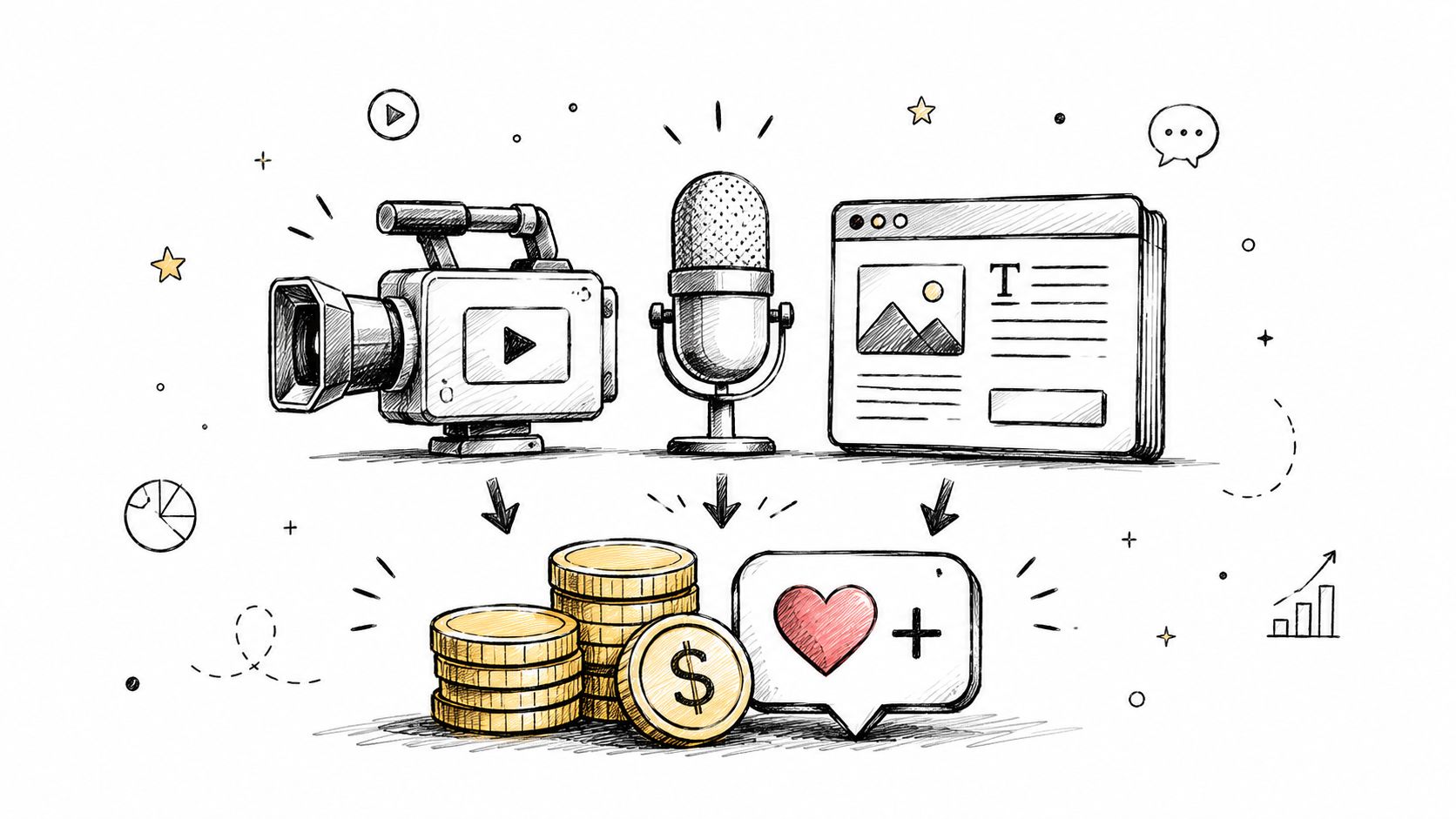
Content creation looks easy from the outside. It isn't. It rewards consistency, clarity, and patience more than raw talent. But it's still one of the strongest side businesses because a good audience can later support products, sponsorships, consulting, memberships, and courses.
Newsletter writers on Substack, podcasters on Spotify, bloggers publishing tutorials, and YouTube educators all follow the same basic pattern. They publish useful material repeatedly until trust compounds.
Consistency matters more than format
Salesforce's side-hustle guidance also calls out niche paid newsletters and Discord communities, with a useful reminder that monetization usually comes after consistent content creation, not before. That tracks with what works. The audience has to care before it pays.
Often, many creators hit a practical wall. Selling subscriptions, gated communities, or digital downloads across borders often means dealing with payment friction, currency conversion, and limited payout options. One creator-focused side-hustle analysis notes that 68% of global digital creators face payment friction when selling internationally.
For creators monetizing globally, Suby is useful because it's one product with four ways to use it. Suby Payments is an API-first payment stack to accept cards and crypto through one checkout. Suby Crypto handles the swap, sponsors the gas, and settles to a non-custodial wallet or to the Suby balance. Suby Gating provides paid access for Discord, Telegram, downloads, and courses. Suby Invoicing lets the client pay how they want while the business receives what it wants. If you're building a media business, this guide on how to make money as a content creator pairs well with broader thinking on future YouTube creator income.
Build the publishing habit first. Most creators quit before the business model has time to work.
4. Dropshipping and Print-on-Demand E-commerce
Dropshipping and print-on-demand attract beginners for one reason. You don't need to buy inventory upfront. That lowers risk, but it doesn't remove the hard part, which is finding a product and an audience that leave enough margin after ads, refunds, and payment costs.
The category is large and still growing. Lightspeed's small business overview says the global dropshipping market is projected to reach $557.9 billion in 2025, with a 28.8% CAGR, and notes that over 1.5 million active Shopify stores use dropshipping as their primary fulfillment method.
The business lives or dies on margins
Those numbers explain why competition is intense. The low barrier to entry is real, but so is the flood of similar stores. Winning stores usually do a few things better than average:
Pick a niche, not a catalog: A pet travel store beats a generic gift store.
Validate with data: Use search interest and ad response before building out a full range.
Fix the offer page: Product images, shipping expectations, and returns policy do a lot of conversion work.
Print-on-demand can be stronger than pure dropshipping if you have a clear audience. A cycling newsletter can sell niche apparel. A developer brand can sell keyboard desk mats. A teacher can sell classroom printables and branded merch.
Suby can support ecommerce merchants selling cross-border with card and crypto payments through one checkout, while businesses choose how to receive funds, including to a bank account or in stablecoins like USDC. One practical flow is simple. The customer pays by card, and the business receives USDC. That's one option among several, not the only setup.
5. Consulting and Coaching Services
Consulting is what people buy when they want a shortcut, judgment, or a proven process. Coaching is what they buy when they need accountability and guided execution. Both work well as side businesses if you already know how to solve a problem that others find expensive, confusing, or time-consuming.
The highest-value version is specific. “AI workflow setup for small law firms” is better than “business consulting.” “Email conversion coaching for course creators” is better than “marketing help.”
Sell outcomes, not vague advice
Specialized technical consulting has clear upside. In a practitioner discussion about side income, freelance data science consulting for small businesses was described as netting approximately $50,000 to $100,000 annually. The same source also notes that creating a SaaS or new product as a side gig carries significant risk and doesn't guarantee revenue, which is exactly why consulting often makes a better first move.
A practical consulting offer usually needs three parts:
A narrow problem: Churn analysis, analytics setup, offer positioning, workflow automation.
A defined package: Audit, strategy session, implementation sprint, or monthly advisory.
A visible result: Better reporting, clearer messaging, less manual work, stronger operations.
Small businesses often want AI and automation help but get stuck on budget concerns and lack of expertise. That creates room for focused advisory services, especially if you can package the work into a clear scope instead of selling open-ended “brain time.”
One warning. Coaching without a real framework usually turns into emotional labor with weak retention. Clients stay longer when you lead them through a repeatable process.
6. Affiliate Marketing and Niche Websites
Affiliate marketing is a trust business disguised as a content business. You create pages, videos, or newsletters that help people choose products, then earn when they buy through your recommendation. The model can work well on the side because content keeps working after you publish it.
This tends to work best in categories where buyers already compare options. Software tools, creator equipment, productivity apps, home office gear, and educational products are common examples.
Trust is the whole model
Thin review sites don't last. Real comparison content does. Good affiliate content shows hands-on use, explains trade-offs, and helps the reader decide between credible alternatives.
A strong niche site usually includes:
Commercial-intent topics: Comparisons, alternatives, setup guides, buying questions.
Repeatable structure: Reviews, versus pages, tutorials, and email capture.
Diversified monetization: Affiliate links, sponsorships, your own products, and consulting leads.
If you already create content, affiliate offers can sit alongside your own monetization. This is especially useful when you don't yet have a product to sell. For creators building this route in 2026, a broader 2026 affiliate marketing guide can help map content to commissions.
The main trade-off is timing. Affiliate sites usually take longer to build than freelancing or consulting. You're investing in an asset, not just selling hours. That's attractive if you're patient and willing to publish consistently around one niche.
7. Virtual Community and Membership Sites
A paid community can be excellent recurring revenue, but only when members join for a specific outcome. “Access to like-minded people” isn't enough. “Weekly teardown sessions for ecommerce operators” or “job leads and portfolio feedback for junior designers” is much stronger.
Communities live or die on participation quality. A quiet group with no structure feels abandoned, even if the topic is good.
Memberships need structure
There's also a practical monetization gap that many mainstream side-business guides skip. One side-hustle analysis points out that creators selling Discord or Telegram memberships often struggle with transaction costs, payout rules, and crypto acceptance, and adds that 42% of community managers now prefer USDC payouts to avoid bank delays and currency risk.
That matters because community businesses are often global from day one. A member in one country may prefer card. Another may prefer wallet or crypto. The operator may want settlement to a bank account or in stablecoins.
Suby is well suited here because it provides an API that lets any business accept payments by card or crypto, and it also offers native integrations with Discord and Telegram for subscriptions, paid access, and online communities. Through Suby Gating, creators can lock memberships, downloads, and courses behind a paywall with no-code setup, as described in this Suby review page on Trustpilot.
A community isn't a chat room. It's a recurring promise that members keep finding valuable.
Start small. Seed the first members manually, host regular sessions, and give people a reason to come back every week.
8. E-learning Course Creation and Sales

Courses work best when they help students reach a defined result, not when they just dump information into videos. A good course saves time, reduces confusion, and gives learners a sequence to follow.
That's why narrow courses often outperform broad ones. “How to build a financial dashboard in Excel” is easier to sell than “learn business analytics.” Buyers want a result they can picture.
Don't build the course in a vacuum
There's a real service opportunity around this too. Salesforce notes that online course creation services for experts address a supply gap because many professionals know their subject but don't know how to set up the technical side of e-learning. If you don't want to be the instructor, you can help experts package their knowledge into a sellable course.
Teaching itself can also be a solid side income. In the same practitioner discussion cited earlier, teaching online or mentoring, such as personalized R programming or math classes, was described as generating $55 per hour or about $1,000 to $1,500 monthly. That makes teaching one of the safer starting points if you already have strong subject matter knowledge.
What works in practice:
Start with repeated questions: Your best course topics are often problems people already ask you about.
Add implementation tools: Worksheets, templates, and examples often matter as much as the videos.
Use mixed delivery: Recorded modules plus office hours often creates a better student experience than either alone.
The trap is overproducing too early. Students care more about clarity, sequence, and relevance than studio-grade editing.
10. Agency Services and White-Label Solutions
A lot of side businesses stall at the freelancer stage. One person gets fully booked, raises rates a bit, then hits a ceiling because every deliverable still depends on their own time. Agency services solve that by turning a skill into a repeatable offer that other people can help fulfill.
That model works well for SEO, paid ads, email marketing, web design, development, short-form video editing, analytics, and marketing automation. White-label delivery makes the jump easier. You sell under your brand, keep the client relationship, and use specialized contractors or partner firms behind the scenes for execution.
Productize before you hire
The cleanest agency offers are narrow. A paid social service for Shopify brands, local SEO for dental clinics, or landing page design for B2B SaaS companies is easier to price, sell, and fulfill than a general "full-service" package. Specialization also helps referrals because clients know exactly who to send your way.
As noted earlier, professional services firms are adopting AI at a meaningful rate. That creates a practical opening for side-business owners who can package AI-assisted content workflows, reporting automation, chatbot setup, or internal process improvements for smaller companies that do not want to build those systems alone.
A simple mini-playbook looks like this:
First step: Pick one service, one customer type, and one measurable outcome.
Starter offer: Build a fixed-scope package with a clear price and timeline.
Fulfillment setup: Document onboarding, reporting, revisions, and handoff in SOPs.
Delivery support: Use freelancers or white-label partners only after the process is stable.
Payments: Set up a checkout flow that can handle retainers, project deposits, invoices, and global clients who may prefer cards or crypto.
Revenue ranges vary a lot here, but the math is usually better than freelance work once the offer is standardized. A solo operator might start with one or two clients at a few hundred to a few thousand dollars per month, depending on the service. A small niche agency with repeatable delivery can grow into consistent monthly recurring revenue faster than many other side businesses on this list. The trade-off is operational complexity. Client management, quality control, deadlines, and contractor coordination become part of the job.
A few practices improve margins quickly:
Sell packages instead of custom proposals: Scope creep destroys profitability.
Use templated reporting: Clients want clarity, not a new dashboard every month.
Set communication rules early: Response windows and revision limits protect your time.
Track fulfillment time by account: The unprofitable client is usually obvious once you measure delivery hours.
The biggest mistake is trying to look bigger than you are before delivery is consistent. Start with a tight service, prove results, document the process, then add people. That order keeps an agency side business profitable instead of chaotic.
10. Agency Services and White-Label Solutions
Agency work is one of the fastest ways to turn freelance skill into a larger business. You stop selling only your personal output and start packaging a service that others can help deliver. SEO, paid ads, design, development, social media management, lifecycle marketing, and analytics are all common agency offers.
White-label work can make this even easier. A small agency might deliver under its own brand while contractors or specialist partners handle parts of fulfillment behind the scenes.
Productize before you scale
The agencies that grow cleanly usually narrow down before they expand. They pick one vertical, one core service, or one problem. A healthcare SEO agency, a paid social shop for ecommerce brands, or a web design agency for law firms is easier to sell than a generic “full-service digital agency.”
Professional services also show meaningful AI traction. The Zoe Talent source cited earlier notes that AI adoption rates in professional services reached 30.3% by 2025, which supports agency offers tied to AI-assisted content, workflow automation, and operational improvement. For small business clients, financial concerns and lack of expertise still block adoption, so agencies that package implementation in a budget-aware way have a clear angle.
Here's what improves agency economics fast:
Standardize delivery: Use templates, SOPs, and repeatable client onboarding.
Sell packages, not custom chaos: Clear deliverables make pricing and staffing easier.
Protect cash flow: Recurring retainers beat project-only revenue for planning and hiring.
Suby can also help agencies and freelancers invoicing clients worldwide who prefer flexible settlement, because customers can pay by card, wallet, bank, or crypto, and the business chooses whether to receive the money to a bank account or in stablecoins like USDC. Pricing depends on the payment method used, so it's best to check Suby pricing for exact figures.
Top 10 Side Businesses Comparison
Side Business | Implementation complexity | Resource requirements | Expected outcomes | Ideal use cases | Key advantages |
|---|---|---|---|---|---|
Digital Product Sales and Downloads | Low–Medium: create product and set up storefront | Low ongoing resources; initial creation time and tools | Scalable passive revenue; high margins per sale | E‑books, templates, plugins, digital assets, repeatable courses | Low overhead; unlimited sales; instant delivery |
Freelance Services (Writing, Design, Development) | Low: portfolio and client onboarding | Time and specialized skills; communication and billing tools | Immediate income tied to hours/projects; variable | Copywriting, design gigs, dev contracts, retainers | Fast to start; flexible schedule; builds reputation |
Content Creation and Monetization (YouTube, Podcasting, Blogging) | Medium–High: consistent production and platform strategy | Time, content equipment, editing tools, audience growth effort | Long‑term passive and diversified revenue; slow to scale initially | Video channels, podcasts, newsletters, blogs | Brand building; multiple revenue streams; compounding content |
Dropshipping and Print-on-Demand E‑commerce | Low–Medium: store setup and supplier integration | Marketing budget, platform fees, supplier management | Low margins per sale; scalable with marketing but fulfillment risk | Niche merchandise stores, custom apparel, themed products | Low capital requirement; no inventory; fast product testing |
Consulting and Coaching Services | Medium: package offerings and credibility building | High expertise, marketing, scheduling and client systems | High per‑client revenue; potential recurring retainers | Executive coaching, business strategy, specialty consulting | Premium pricing; direct client impact; high margins |
Affiliate Marketing and Niche Websites | Medium: content creation plus SEO and monetization | Content, SEO skills, hosting, link building | Passive commissions over time; 6–12+ months to traction | Review sites, comparison blogs, niche product guides | Minimal startup cost; no customer support; scalable traffic |
Virtual Community and Membership Sites | Medium–High: setup plus active community management | Ongoing engagement, moderators, content and platform fees | Predictable recurring revenue; high member LTV if engaged | Professional networks, niche interest communities, cohorts | Recurring income; strong retention; network effects |
E‑learning Course Creation and Sales | Medium–High: curriculum design and production | Time, recording equipment, LMS/platform and marketing | High-margin passive income once marketed; refunds/support needed | Skill training, professional certification, niche courses | Scalable sales; authority building; reusable content |
Niche Software and SaaS Products | High: product development, testing, and ops | Significant development, hosting, support, and sales resources | Predictable subscription revenue and high LTV; longer ROI | Workflow tools, industry‑specific apps, integrations | Recurring revenue; defensibility; high scalability |
Agency Services and White‑Label Solutions | High: processes, team hiring, and client workflows | Skilled staff, operations, sales, project management | Recurring retainers; scalable with team but operational overhead | SEO, social media, web design, paid ads for SMBs | Multiple revenue streams; scalable teams; strong client relationships |
Take Your First Step Today
The best side business is rarely the most glamorous one. It's the one you can start with the skills, time, and energy you already have, then improve through real customer feedback. That's why service businesses often beat product businesses at the beginning. They generate cash faster, teach you what buyers want, and force you to sharpen your offer.
If you want the lowest-risk starting point, freelancing, consulting, coaching, and teaching are hard to ignore. They let you sell existing expertise without inventory, product development, or a large upfront bet. If you want something that can scale beyond your time, digital products, courses, memberships, niche content, and software become more attractive, but they usually take longer to validate and require more patience.
The right choice depends on what you're optimizing for. If you need faster income, start with a service. If you want a business asset that can grow while you sleep, start creating content, products, or systems you can sell repeatedly. If you already understand a market thoroughly, a niche SaaS or agency offer can be a strong next step. If you enjoy curation and trust-building, affiliate content and membership communities can become durable businesses over time.
A lot of people get stuck because they compare business models before they've tested any of them. Don't do that for too long. Pick one narrow idea and pressure-test it in practice. Offer a service to five prospects. Publish three pieces of content in one niche. Put one template up for sale. Run one workshop. Build one small tool for one painful workflow. Momentum comes from contact with buyers, not from endless planning.
The other big shift in 2026 is that even tiny side businesses can operate globally. That creates upside, but it also raises practical questions about checkout, subscriptions, invoicing, taxes, currency conversion, and payout preferences. If your customer wants to pay by card and you want to receive USDC, your tools should support that. If your buyers are in different countries, your payment stack shouldn't be the bottleneck. Customers pay any way they want, businesses get paid the way they choose. That flexibility matters more as soon as your side business reaches beyond one local market.
Start smaller than you think you need to. Just don't stay small in your commitment. A focused offer, consistent execution, and a payment setup that supports global buyers can take a side project much further than is often anticipated.
Suby is a payment gateway for anyone starting a side business. Your customers pay with card, bank transfer, Apple Pay, Google Pay, Klarna, and more, or crypto, and you get paid out to your bank account, or in stablecoins (USDC, EURC) to your wallet, anywhere in the world with no bank account required. Whatever side business you pick, that lets you take money from day one with a paylink or checkout, without waiting on a local entity or a bank. Check the Suby pricing page for exact costs, since pricing depends on the payment method used.
