


Accepting crypto payments isn't some niche experiment for tech insiders anymore. It's become a smart, strategic way to open up global revenue streams, drastically cut fees, and make cross-border sales a whole lot simpler.
This guide is designed to cut through the noise and give you a practical look at what it really means to accept crypto today. We're not talking about speculative trading—we're talking about using stablecoins like USDC for predictable, fast, and reliable settlements.
Why Your Business Should Seriously Consider Crypto Payments

The conversation around digital currency has fundamentally shifted. We've moved past abstract ideas and into tangible business benefits. Companies of all sizes, from SaaS startups to established e-commerce brands, are now adding crypto payment options—not as a gimmick, but as a core piece of their financial toolkit.
This isn't happening by accident. It's a direct response to the very real pain points of traditional finance. Think about it: international transactions through old-school systems like SWIFT often mean waiting days for funds to clear while getting hit with hefty currency conversion fees. That friction is a real headache, especially if you have customers all over the world.
By accepting crypto—specifically stablecoins—you can sidestep all of that. A payment from a customer in Asia can land in a U.S. company's digital wallet in a matter of minutes, not days, and for a fraction of the cost.
Unlocking Global Markets
One of the biggest wins when you learn how to accept crypto payments is immediate access to new customers. In many parts of the world, getting an international credit card or even a traditional bank account can be a major hurdle. What isn't a hurdle is access to the internet and smartphones, which has made digital wallets a common tool for millions.
By offering a crypto payment option, you can instantly connect with these underserved markets. This opens up revenue streams that were completely out of reach before. It's about leveling the playing field and letting you compete globally without the nightmare of setting up local banking relationships in every single country.
The market's explosive growth tells the story. The global Bitcoin Payment Ecosystem market is expanding rapidly, with major players fundamentally changing how businesses handle cryptocurrency. You can dig into a full report on the Bitcoin payment ecosystem for a deeper look, but the takeaway is clear: crypto is moving from a niche curiosity to a mainstream business necessity.
To put it in perspective, let's look at a quick comparison.
Crypto Payments vs Traditional Payments At a Glance
Here’s a straightforward breakdown of how a modern crypto payment setup stacks up against the banking systems we've used for decades. The differences in speed, cost, and accessibility are pretty stark.
FeatureCrypto Payments (Stablecoin Settlement)Traditional Payments (Cards/SWIFT)Settlement SpeedMinutes2-7 business daysTransaction FeesTypically ~1% or less2.9% + $0.30 for cards; $25-$50+ for international wiresGlobal ReachInstantly global; anyone with a digital wallet can payLimited by local banking infrastructure and card network availabilityChargeback RiskEliminated; transactions are finalHigh risk of "friendly fraud" and costly dispute processesCurrency Volatility RiskRemoved by using USD-pegged stablecoins like USDCSubject to fluctuating exchange rates and conversion fees
This table really highlights the core value proposition. You're not just adopting a new payment method; you're upgrading your entire financial infrastructure to be faster, cheaper, and more inclusive.
The Practical Benefits of Modern Crypto Payments
Beyond just reaching more customers, the day-to-day advantages are what really seal the deal. Modern crypto payment systems are built for simplicity. In many cases, getting started is as easy as embedding a checkout link on your website.
Here are a few of the key benefits you'll see right away:
- Eliminate Chargeback Fraud: Blockchain transactions are final. This means the risk of "friendly fraud"—where a customer disputes a legitimate charge—is virtually gone, along with the administrative headaches that come with it.
- Predictable Revenue with Stablecoins: When you settle payments in a stablecoin like USDC, your revenue is pegged to the US dollar. This completely removes the price volatility you'd see with cryptocurrencies like Bitcoin or Ethereum.
- Reduced Operational Overhead: You can manage all your global sales, invoicing, and payouts from a single digital wallet. This dramatically simplifies your accounting and treasury management.
Ultimately, accepting crypto is about gaining a real competitive advantage. You're embracing a payment system that's built for the internet—one that’s faster, more affordable, and truly global from the ground up.
Choosing Your Payout Model: Crypto vs. Stablecoins
One of the very first—and most critical—decisions you'll make when you start accepting crypto is how you actually want to get paid. This isn't just a technical detail; it fundamentally shapes your financial operations, from how you do your accounting to whether you can even predict your monthly revenue.
You're looking at two main paths: holding the crypto you receive directly (like Bitcoin or Ethereum) or having it instantly settled as a stablecoin like USDC.
The Case for Volatile Crypto Payouts
Let's be honest, holding native crypto like Bitcoin can be tempting. If you’re a big believer in its long-term growth, the idea is appealing. A customer pays you, and if the coin’s value shoots up, you've just increased your revenue without doing a thing.
But that potential gain comes tethered to some serious risk.
The price swings of assets like Bitcoin and Ethereum are legendary. A payment worth $1,000 today could easily be worth $850 tomorrow. This volatility turns your hard-earned revenue into a speculative bet, creating chaotic cash flow and a nightmare for your accountant. Most businesses just aren't set up to handle that kind of financial gamble.
So, who would actually choose this route? It’s a small group, but there are a few scenarios where it makes sense:
- A Long-Term Treasury Strategy: Some companies, especially those deeply embedded in the Web3 world, intentionally hold crypto on their balance sheets as part of a long-term investment play.
- Paying Crypto-Native Expenses: If you're already paying suppliers, contractors, or employees in a specific crypto, then it can be simpler to just hold that asset and avoid constantly converting back and forth.
- A High-Risk, High-Reward Appetite: For the rare business with an iron stomach for financial risk, the potential for a big payoff might just outweigh the daily stress of volatility.
For the vast majority of businesses, though, this level of uncertainty is a non-starter. And that’s exactly where stablecoins come in to change the game.
Why Stablecoins Are the Default for Most Businesses
Stablecoins give you the best of both worlds. You get all the benefits of crypto—the speed, the global reach, the low transaction fees—but without the stomach-churning price swings. A stablecoin like USDC is pegged 1:1 to the US dollar. That means one USDC is designed to always be worth one US dollar.
This stability is a game-changer for merchants.
When a customer pays you $100 in USDC, you can be confident that it's still going to be worth $100 when you check your wallet next week. It completely removes the guesswork and lets you treat your crypto revenue just like you would any other currency.
The real magic of stablecoin settlement is predictability. It lets you use the powerful rails of the blockchain for payments without turning your company's revenue into a speculative trading position.
The industry is moving quickly in this direction. A recent report found that 45% of payment industry professionals see cross-border payments as the area where stablecoins will have the biggest impact. It makes perfect sense—they solve the one core problem that has always scared mainstream businesses away from crypto: volatility. You can dig into these findings and other payment trends for 2026 on checkout.com.
Here’s a look at how clean and simple USDC settlements are inside the Suby dashboard. Notice how every transaction is listed in a stable USD value.
It looks and feels just like a statement from a traditional payment processor, giving you a clear, easily reconcilable record of your income.
Ultimately, this choice boils down to your company's risk tolerance and operational style. If you want to dive even deeper, we wrote a full guide on the differences between USDC and native crypto pricing. But for most businesses, the stability and simplicity that USDC settlements offer make it the obvious and smartest choice.
How to Select the Right Crypto Payment Provider
Choosing your crypto payment provider is one of the most critical decisions you'll make. This isn't just about finding a tool to process transactions; you're selecting a partner that will shape your customer experience, impact your bottom line through fees, and handle a core part of your security. It’s a choice that goes way beyond a simple rate comparison.
Not all providers are cut from the same cloth. Some are built for crypto-native companies that are comfortable holding volatile assets. Others, like Suby, are designed to give mainstream businesses what they actually need: stable, predictable settlements in USDC. The goal is to find a partner whose model truly aligns with your business goals and how you operate.
Looking Beyond the Headline Transaction Fee
The biggest mistake I see businesses make is getting fixated on the advertised transaction fee. A provider might flash a low 0.5% fee, but that number rarely tells the whole story. You absolutely have to dig deeper to uncover the hidden costs that can eat into your margins.
For example, many providers pass network fees—often called "gas fees"—directly onto you or your customer. These fees can swing wildly depending on how busy the blockchain is, potentially turning a small, profitable sale into a loss. Likewise, conversion charges for swapping between different cryptos or settling into fiat can take a surprisingly large bite out of your revenue.
To get the real picture, you need to ask for a complete fee breakdown.
- Transaction Fees: What's the base percentage or flat fee?
- Network (Gas) Fees: Who covers these? Are they bundled in, or are they an extra, variable cost?
- Settlement & Payout Fees: What does it cost to actually get your money out or convert it?
- Monthly or Hidden Fees: Are there any platform fees, setup costs, or extra charges for support?
Getting clarity on these points is the only way to accurately forecast your costs and find a solution that’s genuinely cost-effective.
Essential Features for Modern Businesses
Once you have a clear handle on the costs, it's time to look at the feature set. The right tools can make accepting crypto feel effortless, while the wrong ones will create constant operational headaches. What you need really depends on your business model—a SaaS company, an e-commerce store, and a solo creator all have different priorities.
A subscription-based software company, for instance, absolutely requires a provider that supports automated recurring billing. This is a surprisingly rare feature in the crypto world because it demands a more complex infrastructure than simple one-time payments.
A provider's real value isn't just in processing a payment. It's in giving you the complete toolkit you need to run your business efficiently, from flexible integration options to rock-solid security.
Here’s a checklist of key features to keep an eye out for:
- Multiple Integration Options: Can you create simple payment links, embed a checkout widget, or do you need a full API for custom workflows? A great provider offers all three.
- Support for Subscriptions: If you rely on recurring revenue, make sure the platform has native support for automated subscription billing and management.
- Stablecoin Settlement Focus: Does the provider default to USDC or another stablecoin for settlements? This is non-negotiable for protecting your business from price volatility.
- Security and Compliance: Look for transparency around their security measures, like PCI compliance and support for two-factor authentication (2FA).
Asking the Right Questions Before You Commit
Before you sign on the dotted line, it’s time to have a direct conversation and ask some tough questions. The answers you get—or don't get—will tell you a lot about their reliability, expertise, and how much they value their customers. This is your chance to vet them and make sure there are no nasty surprises waiting for you later.
Think of it like hiring a key employee. You need to be confident they have the technical chops and operational discipline to support your growth. For a broader perspective on payment processing solutions, you can always consult resources from general payments experts to get wider industry context for your evaluation.
A solid provider should have no problem giving you straight answers about their settlement times, how they handle disputes, and what their technical support looks like. Vague responses are a huge red flag. If you come prepared with a list of pointed questions, you can cut right through the marketing fluff and find a true partner for your business.
Getting Crypto Payments Up and Running in Your Business
Alright, you've picked your provider. Now for the fun part: actually wiring everything up so you can start accepting crypto. This is where the idea of global, low-fee payments becomes a reality for your business. The great news is you have options, and you don’t need a team of blockchain engineers to make it happen.
You can get a global payment solution live in just a few minutes. Let's walk through the three main ways to do this, from simple links you can create in seconds to a full-blown developer integration.
First, a quick reminder of why choosing the right provider is so critical—it's the foundation for everything that follows.
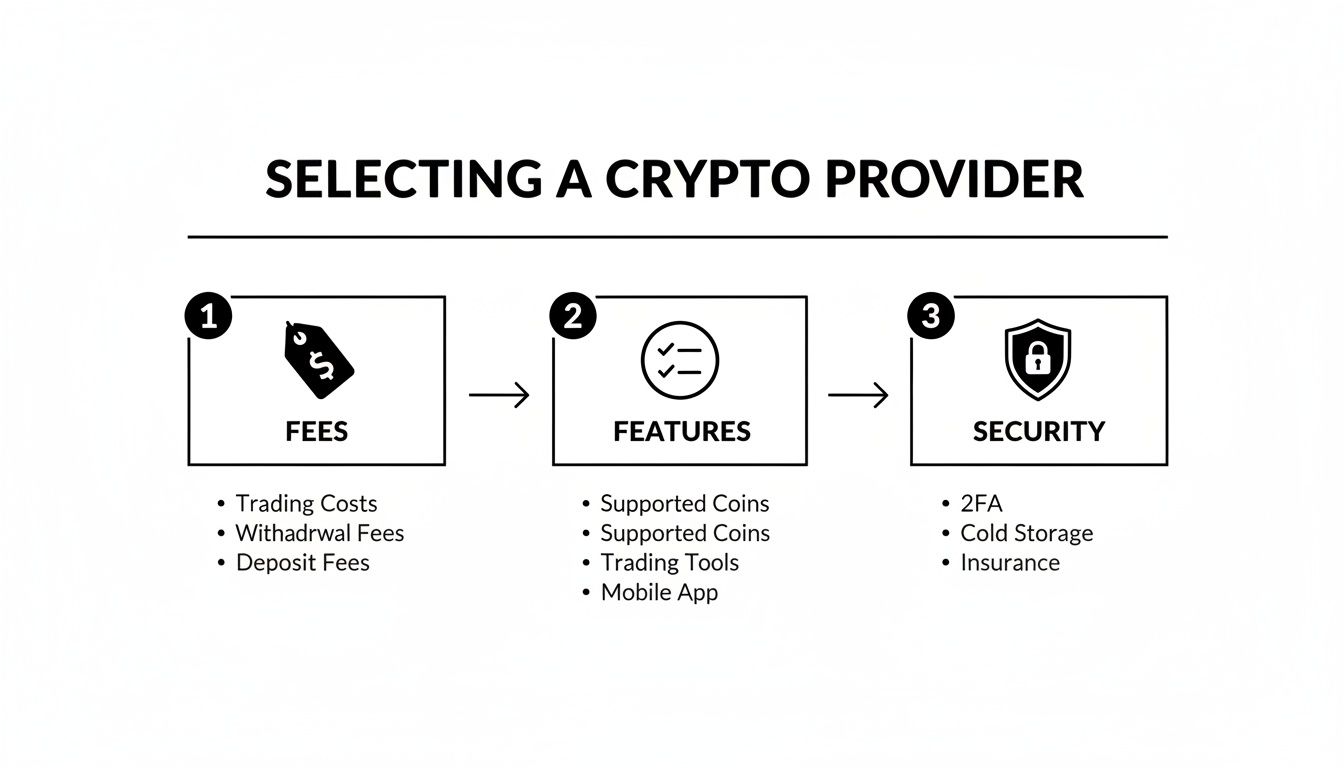
A solid choice here makes the entire integration process smoother, ensuring your payment system is reliable from day one.
The No-Code Route: Sharable Paylinks
The absolute fastest way to start accepting crypto is with sharable paylinks. This requires zero coding. Seriously. If you can copy and paste a link, you can do this.
Think of a paylink as a smart invoice. You generate a unique link for a product or service, set the price, and then send it to your customer—over email, in a chat, or even in your social media bio. When they click, they land on a clean, hosted checkout page to pay with their crypto wallet. It's that simple.
This is a game-changer for a few types of businesses:
- Freelancers and Agencies: Invoice that client in another country and get paid in stable USDC without waiting on SWIFT transfers or losing a chunk to bank fees.
- Creators: Selling a digital course or a pack of presets? Drop a paylink in your Linktree and you're good to go.
- Service-Based Businesses: Collect a deposit for a consultation or a project milestone without any website fuss.
Everything is managed from your provider's dashboard. You can create, track, and see the status of all your links in one place, making it incredibly easy to manage.
The Low-Code Method: Embedded Checkouts
If you have a website for your e-commerce store or SaaS platform, an embedded checkout widget is your best bet for a professional feel. This is a low-code option that gives you the look of a native integration without the heavy technical lift.
You’ll typically be given a small snippet of code from your payment provider. Just copy and paste it into your website's HTML where you want the payment button to appear. When a customer clicks it, a sleek checkout modal pops up right on your page. No jarring redirects to another website.
This approach hits the sweet spot between ease of use and a great user experience. It keeps customers on your site and under your brand, which is a huge deal for keeping conversion rates high.
Imagine a SaaS company with an "Upgrade to Pro" button. A click could trigger the embedded checkout, letting a user pay for a subscription with crypto in seconds. The widget does all the hard work in the background—showing the QR code, waiting for the blockchain confirmation, and displaying the success message—all within your site’s familiar design. Plus, offering multi-chain acceptance lets customers pay from their preferred network, whether that’s Solana, Base, or Ethereum.
Full Integration: APIs and Webhooks
For businesses that need total control, deep customization, and slick automation, a full integration using APIs (Application Programming Interfaces) and webhooks is the way to go. This is the developer's playground, where you can build truly custom payment flows.
Using an API, your system can programmatically do things like create product plans, manage subscriptions, and generate a unique payment address for every single order. This isn't just nice to have; it's essential if you're handling a high volume of customers.
Webhooks are the other critical piece of the puzzle. They're basically automated alerts that your payment provider sends to your application whenever something happens. For example, once a customer's payment is confirmed on the blockchain, a webhook can kick off a chain reaction:
- Grant Access: Instantly unlock the premium features of your SaaS product for the user.
- Fulfill Order: Ping your inventory system to start packing and shipping a physical item.
- Send Confirmation: Trigger a personalized "Thank You" email to your customer.
This real-time automation is what makes an API integration so powerful. It cuts out manual tasks, prevents errors, and gives your customers the instant gratification they expect. Building this kind of system means crypto isn't just a payment method; it's a core, scalable part of your business operations.
What to Do After the Payment Clears
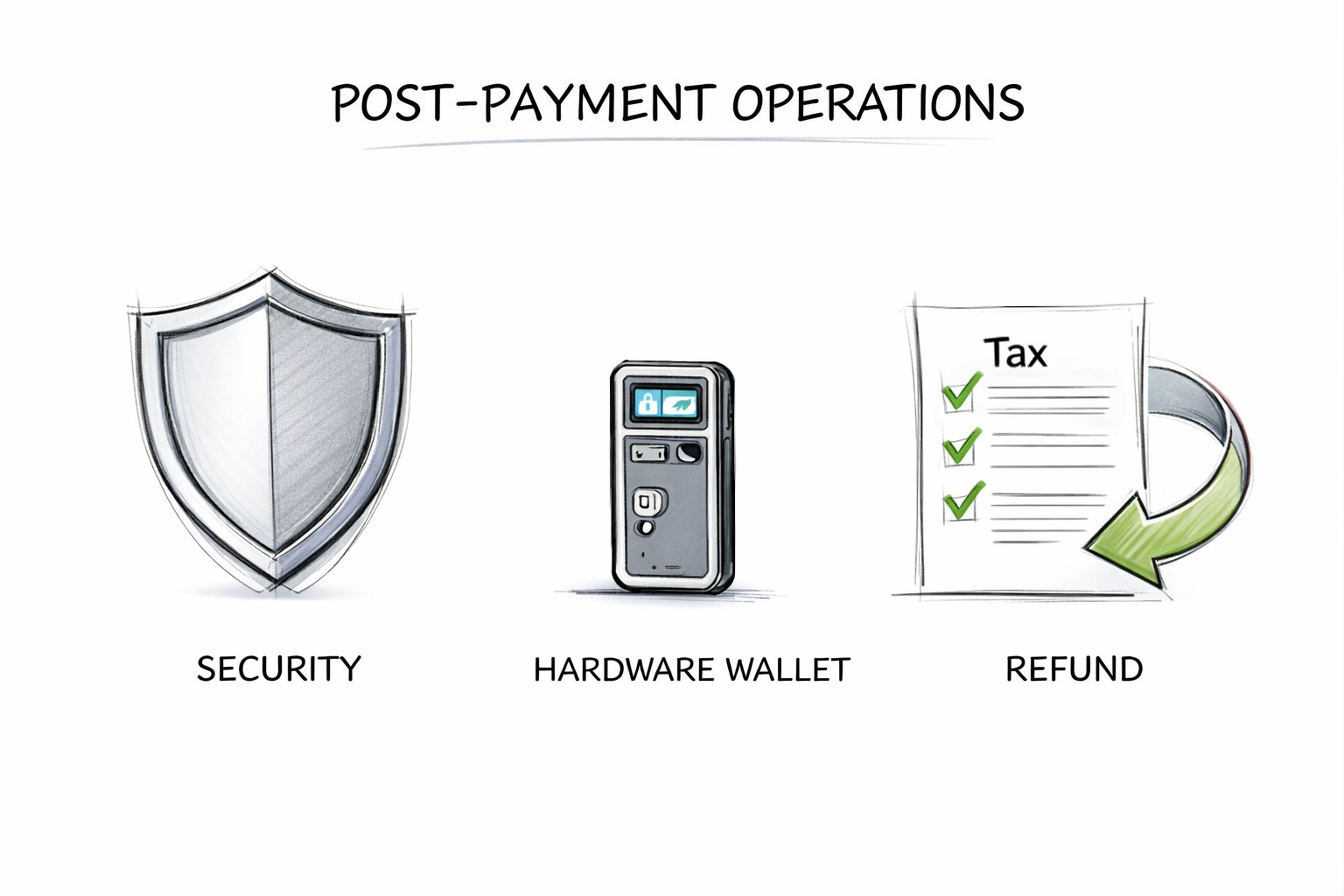
Getting that first crypto payment is a great milestone, but the work doesn't stop there. What you do next—managing security, handling the books, and dealing with customer issues—is what separates a hobby from a real, sustainable business operation.
This is where many businesses stumble. They focus so much on the "accepting" part that they neglect the "managing" part. Let's make sure you have a solid plan for everything that comes after a transaction.
Keeping Your Funds Safe: Essential Security Practices
Now that you have crypto revenue coming in, protecting it is priority number one. With crypto, you are your own bank, which means the responsibility for security falls squarely on your shoulders. It's a different mindset, but not a difficult one to adopt.
Think about your wallet setup. The software wallet (or "hot wallet") from your payment provider is perfect for day-to-day transactions, but you shouldn't let large balances build up there. For your long-term savings, a hardware wallet is the gold standard. These are physical devices that keep your private keys totally offline, making them untouchable by online threats.
Beyond that, it's about good old-fashioned digital hygiene:
- Use Multi-Factor Authentication (MFA): Turn it on for everything—your payment provider, your email, everything. An authenticator app is far more secure than SMS codes.
- Lock Down Your Passwords: Every service needs a unique, complex password. A password manager isn't just a nice-to-have; it's a must.
- Watch Out for Phishing: The crypto world is filled with scammers trying to trick you. Be intensely skeptical of any email or message asking for your private keys or seed phrase. Never share these with anyone, for any reason.
Untangling Crypto Taxes and Accounting
This is the part that scares most people, but it’s completely manageable with the right approach. The secret is simple: keep meticulous records from the very beginning.
Most tax agencies, like the IRS, view crypto as property, not currency. This means almost every transaction is a taxable event—when you receive a payment, when you convert it, when you cash out. You need to log the fair market value in your local currency at the moment of each transaction.
My best advice? Find an accountant who actually has experience with digital assets. They'll know the specific rules and can save you a world of headaches. Trying to fit crypto into a traditional bookkeeping system is a recipe for disaster.
Here’s a pro tip: using a provider that settles your payments in a stablecoin like USDC makes this so much easier. Because USDC is pegged 1:1 to the US dollar, you sidestep the volatility of assets like Bitcoin. No more complex capital gains calculations on every single sale—your records will show stable dollar values, which makes reconciliation a breeze.
Handling Refunds and Disputes Like a Pro
One of the biggest myths about crypto is that all transactions are final, making refunds impossible. While it’s true that you can't reverse a transaction on the blockchain itself, any modern payment provider has built a system to handle refunds and disputes professionally.
When a customer needs their money back, you simply initiate the refund from your provider’s dashboard. The platform takes care of sending the crypto back to the customer's wallet. Most good providers do this without charging extra fees, so you can offer great customer service without it costing you.
This is absolutely crucial for building trust. Your customers need to feel confident that if something goes wrong, they have options. Choosing a platform with solid refund tools protects your reputation and keeps your customers happy.
For a deeper dive into staying on the right side of regulations, our guide on navigating crypto compliance is a great resource. And as you grow, maintaining a continuous compliance system becomes essential for long-term health.
To help you stay on track, we've put together a quick checklist of the key post-payment tasks you'll need to manage.
Essential Post-Payment Checklist
This table breaks down the core operational areas you need to focus on after a crypto payment has been successfully processed.
Operational AreaKey ActionWhy It MattersSecurityPeriodically move funds from your "hot wallet" to an offline hardware wallet for long-term storage.Reduces exposure to online threats and protects your accumulated revenue from potential hacks.AccountingRecord the fiat value of every crypto transaction at the time it occurs.Ensures accurate bookkeeping and makes tax filing straightforward, avoiding costly compliance issues.Tax ComplianceSettle payments in a stablecoin like USDC to minimize capital gains/losses calculations.Drastically simplifies your accounting by removing the volatility factor from your revenue stream.Customer ServiceUse your payment provider's dashboard to process refunds promptly when requested.Builds trust with customers and protects your business's reputation by offering reliable support.Compliance & ReportingMaintain a clear, auditable trail of all transactions for potential regulatory or tax inquiries.Prepares you for audits and demonstrates that your business operates professionally and transparently.
Treating these post-payment steps as an integral part of your workflow will ensure your venture into crypto payments is not only successful but also secure and sustainable for the long haul.
Common Questions About Accepting Crypto
Diving into crypto payments for the first time? It's natural to have questions. This is new territory for most businesses, and it’s smart to get a clear picture before you jump in. We've pulled together the most common questions we hear and answered them directly, so you can move forward with confidence.
Is Accepting Crypto Legal and Safe for My Business?
Yes, in most places like the United States and the European Union, accepting crypto is perfectly legal. The regulatory environment is definitely still taking shape, so the key is to treat it with the same seriousness as any other financial part of your business.
For any business, safety really boils down to two things: partnering with a compliant provider and having solid internal security practices. A good payment provider will handle the heavy lifting on compliance—think Know Your Customer (KYC) and Anti-Money Laundering (AML) checks. Your part is to secure your accounts with multi-factor authentication and manage your funds smartly, just like you do with a regular bank account.
Will I Have to Deal with Price Volatility?
This is probably the biggest worry we hear, and the answer is a simple no, you don't have to. While cryptocurrencies like Bitcoin and Ethereum can swing wildly in value, modern payment systems are built specifically to shield you from that risk.
The solution is settling in stablecoins like USDC. When a customer pays you, the money is instantly settled in a currency pegged 1:1 to the US dollar. This means $50 in revenue you earn today is still $50 next week. You get all the perks of the blockchain—like speed and global reach—without gambling with your revenue.
You are not required to hold volatile assets on your balance sheet. By choosing a provider that offers automatic USDC settlement, you can completely sidestep the risks of market swings and maintain predictable cash flow.
Are the Transaction Fees Really Lower Than Credit Cards?
In many cases, yes—but you have to look at the total cost. A typical credit card transaction runs about 2.9% + $0.30. A crypto payment processor might charge a flat 1-5%. That upper range might look higher at first glance, but crypto payments completely get rid of several hidden costs that add up with traditional finance.
With crypto, you’re no longer paying for:
- Cross-border fees that banks slap on international transfers.
- Currency conversion (FX) fees, which can skim off another 1-3%.
- Chargeback fees, which can cost you anywhere from $20-$100 per incident.
When you add it all up, especially if you sell internationally, learning how to accept crypto payments often leads to a much lower effective fee rate.
How Do I Handle Taxes for Crypto Payments?
Taxes are completely manageable as long as you keep good records. Most tax authorities, including the IRS, view cryptocurrency as property. This just means you need to record the fair market value in your local currency (like USD) at the time you receive each payment.
This is another reason why settling in stablecoins is such a game-changer. Since one USDC is always worth one dollar, your bookkeeping is incredibly simple. You don't have to worry about calculating complex capital gains or losses on every single sale, which makes life a lot easier for you or your accountant. The best move is to work with an accountant who knows their way around crypto to ensure you stay compliant.
What if a Customer Wants a Refund?
Refunds are a normal part of business, and that doesn't change with crypto. It’s true that a transaction on the blockchain itself can't be reversed, but that absolutely does not mean you can't give a customer their money back.
Any legitimate crypto payment provider has a refund system built right into their platform. You can log into your dashboard and issue a refund just as you would with a tool like Stripe. The provider takes care of sending the funds back to the customer's wallet. Offering refunds is essential for building trust, and it's a standard feature you should expect.
Do I Need to Be a Tech Expert to Get Started?
Not at all. The best platforms today are built for business owners, not developers. If you can set up a PayPal account, you have all the skills you need to get started with crypto payments.
You can usually begin with no-code options, like creating a payment link you can share anywhere in just a few minutes. For your website, adding a checkout button is often as simple as copying and pasting a line of code. You'd only need a developer if you were looking to build a deeply customized integration with an API. The barrier to entry is lower than it's ever been.
Ready to unlock global revenue and simplify your payments? With Suby, you can start accepting card and crypto payments worldwide with instant USDC settlements. Get your first payment link live in minutes. Explore Suby today!


