


If you're looking for a SellHub alternative, you have likely run into the usual headaches that come with traditional payment processors. The best options today are built for global reach, quick settlements, and clear fees. They often connect standard card payments with stablecoin payouts like USDC to fix problems modern businesses face.
Why Businesses Need a SellHub Alternative
For many online businesses, especially those with customers around the world, typical payment solutions just create friction. The root of the problem is an outdated financial system that was not designed for the speed and borderless reality of the internet. This leads to a few common pain points that send merchants searching for a better way to get paid.
Slow settlement times are a huge issue. Old-school systems can lock up your funds for days or even weeks, which disrupts your cash flow and makes financial planning difficult. On top of that, high cross-border fees and unpredictable currency conversion rates can quietly eat away at your profit margins, making international sales less rewarding than they should be.
This is where modern solutions come in, bridging the gap between how customers want to pay and how businesses want to get paid.
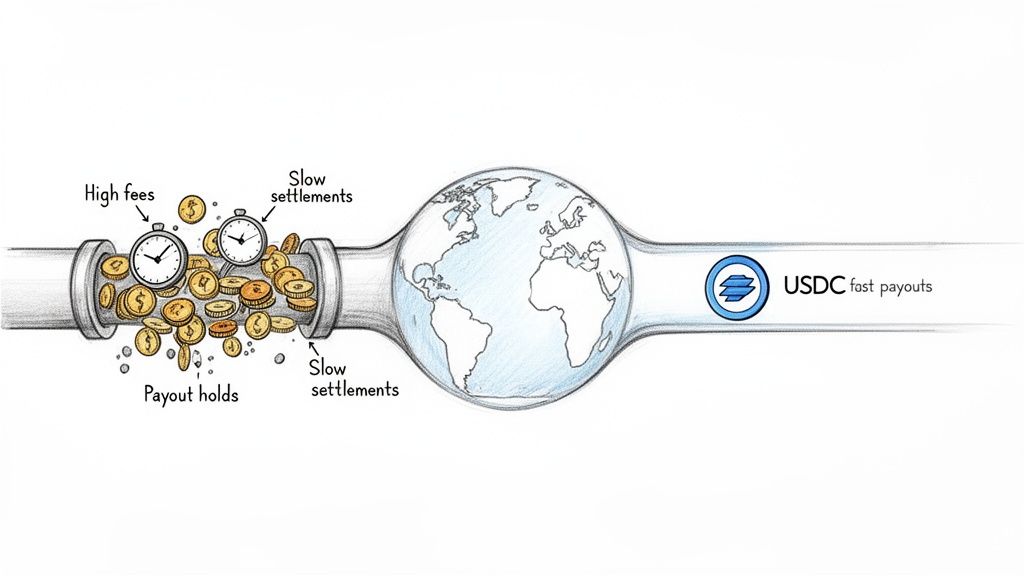
While platforms that facilitate digital sales are useful, they often rely on conventional banking rails. For businesses that need faster, more efficient global settlements, these systems can feel very restrictive.
The Growing Demand for Modern Payment Solutions
The need for better payment gateways is obvious when you look at the market's growth. The global payment gateway market was valued at USD 26.79 billion in 2022 and is on track to hit USD 132.24 billion by 2030, growing at a rate of 22.2% each year. This is not just a trend, it is a fundamental shift in how businesses handle money across borders. You can dig deeper into the latest fintech statistics and trends to see the full picture.
A flexible, global-first payment solution is a necessity. Businesses need a system where a customer can pay with their card, and the merchant gets stable, predictable funds like USDC without the delays or hidden fees.
Bridging Traditional and Modern Payments
This is exactly where the right SellHub alternative shines. Platforms that blend familiar payment methods with stablecoin settlements offer a practical, direct solution to these challenges.
Here’s how they solve the key problems:
- Global Card Payments: Your customers can pay with their credit or debit card from anywhere in the world, giving them a checkout experience they know and trust.
- USDC Settlements: Instead of waiting on slow bank transfers, you receive your revenue directly as USDC. It's fast, secure, and does not suffer from the volatility of traditional currency conversions.
- Simplified Integrations: A modern alternative should have a simple API and out-of-the-box integrations for platforms like Discord and Telegram. This makes it easy to manage subscriptions and paid communities without extensive custom code.
SellHub vs. The Competition: A Head-to-Head Look
If you're looking for an alternative to SellHub, you are likely hunting for more than just a clone. The real goal is to find a platform that keeps SellHub's core strengths while fixing its biggest weaknesses, especially for businesses that operate globally. SellHub gets the job done for selling digital products, but its payment and settlement systems are stuck in the slow lane of traditional banking.
This comparison will cut straight to the chase, focusing on what really matters: how you accept payments, what currency you get paid in, how transparent the pricing is, and how easily the tool plugs into your existing setup. These are not just features, they directly affect your cash flow, operational sanity, and ability to grow beyond your borders. For any international business, how you get paid is just as critical as what you sell.
Core Offerings at a Glance
SellHub has a reputation for being a simple way to sell digital goods. But when you start looking around, you quickly see where the cracks are. A good place to start is the Selzee platform, which gives you a solid baseline for what standard platforms offer these days.
Most alternatives, SellHub included, let your customers pay with credit cards and settle the funds in traditional currencies like USD or EUR. That's perfectly fine if you're only selling domestically. The moment you go international, though, you get hit with currency conversion fees and frustrating payout delays. This is exactly the friction Suby was built to eliminate.
The real game-changer is the settlement layer. With Suby, your customers pay with their card just like anywhere else, but you receive the funds instantly as USDC. This one change completely sidesteps the volatility and delays tied to cross-border bank transfers.
This card-to-USDC model means you get your money faster, your cash flow becomes predictable, and you can say goodbye to hidden foreign exchange fees. It’s a fundamental shift in thinking that redefines what a payment platform can do for a modern global company. For a deeper dive into this kind of payment solution, check out our guide on finding an alternative to Stripe.
High-Level Feature Comparison SellHub vs Alternatives
To really see how these platforms stack up, a side-by-side view is best. The table below breaks down the crucial differences between SellHub, a typical alternative, and Suby, highlighting how they approach payments and settlements for online businesses.
.tbl-scroll{contain:inline-size;overflow-x:auto;-webkit-overflow-scrolling:touch}.tbl-scroll table{min-width:600px;width:100%;border-collapse:collapse;margin-bottom:20px}.tbl-scroll th{border:1px solid #ddd;padding:8px;text-align:left;background-color:#f2f2f2;white-space:nowrap}.tbl-scroll td{border:1px solid #ddd;padding:8px;text-align:left}FeatureSellHubAnother AlternativeSubyCustomer Payment MethodsPrimarily credit/debit cards.Credit/debit cards, sometimes regional payment options.Credit/debit cards and crypto (USDC, USDT, etc.).Merchant Settlement CurrencyTraditional fiat (e.g., USD, EUR).Fiat currencies, often with multi-currency bank accounts.USDC only.Settlement SpeedDays to weeks, subject to bank processing times and holds.Typically 2-7 business days, depending on the region.Near-instant, not reliant on banking hours.Cross-Border FeesCurrency conversion fees and international transfer costs apply.Often includes FX markups and wire fees for payouts.No FX fees. The settlement is natively in USDC.Primary Target AudienceDigital creators and small businesses focused on domestic markets.E-commerce stores and SaaS with regional focus.Global SaaS, e-commerce, and creators needing borderless payments.Key IntegrationsBasic webhooks and third-party app connections.Standard e-commerce platform plugins and API access.API-first design with native Discord and Telegram integrations.
This comparison reveals a clear difference in philosophy. SellHub and its traditional peers are essentially bolting web features onto old-school financial rails. Suby, on the other hand, rebuilt the rails from the ground up for the internet.
It’s built around a powerful API that lets any business accept payments by card or crypto, and we also offer native integrations for Discord and Telegram for use cases like subscriptions and online communities. The value proposition is simple and consistent: your customers pay with cards, and you get stable, liquid USDC. It’s an approach that directly serves the needs of a truly global, internet-first business.
Feature and Functionality Deep Dive
When you're looking for a SellHub alternative, a simple feature checklist won't cut it. The real story isn't just what a platform does, but how it does it. This includes everything from the moment a customer pulls out their credit card to the second that money actually hits your account. This is where you see the stark difference between old-school payment models and modern solutions built for a global economy.
SellHub and many of its peers run on a familiar, but often painfully slow, foundation. A customer pays, the money gets tangled in a web of intermediary banks, and after a few days and a few fees, it finally shows up. Let's pull back the curtain on that process and see how it stacks up against a system designed for right now.
Deconstructing the Payment and Settlement Flow
The heart of any payment processor is its settlement flow, the journey your money takes to get to you. With platforms like SellHub, that journey often goes through archaic financial rails that simply weren't built for the speed of the internet.
A platform like Suby, on the other hand, completely rethinks this entire flow. While the customer-facing experience is still a simple card payment, what happens behind the scenes is fundamentally different. The entire goal is to slash delays and hidden fees by changing how money is settled.
This diagram shows just how direct that journey can be, moving from a customer’s card payment straight to a USDC settlement in your account.
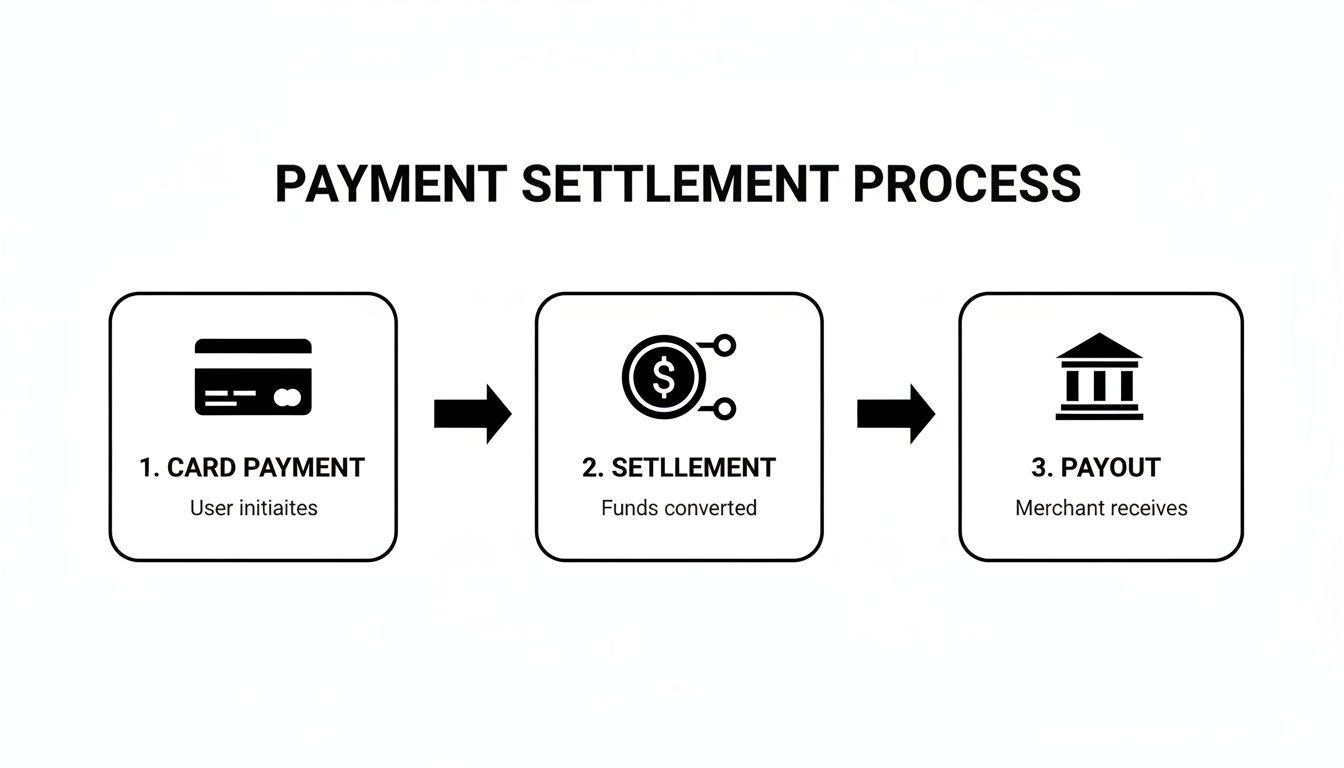
The big takeaway here is the removal of all those middle-man banking steps. Those are precisely where delays and surprise fees tend to pop up, especially when you’re dealing with international customers. By settling directly in USDC, the system neatly sidesteps the friction that plagues cross-border payments.
Subscription Management for Predictable Revenue
If you’re running a SaaS company or selling memberships, subscription management is everything. SellHub offers the basics for recurring billing, but once you start managing a global customer base, things get messy. Currency swings can throw your monthly recurring revenue (MRR) into chaos, and failed payments from international cards become a constant headache.
A true SellHub alternative has to tackle these problems head-on. Suby’s subscription engine is built around its core settlement model: your customers pay with their local card, and you receive stable USDC. This delivers a few huge advantages for any recurring revenue business.
- Stable MRR: Because every single subscription payment settles in USDC, your revenue is insulated from fiat currency volatility. A $20 subscription always brings in 20 USDC, period. No more watching your MRR dip because of a bad day on the forex markets.
- Go Global, Instantly: You can offer recurring billing to customers anywhere on the planet without worrying about regional banking quirks or managing a dozen different currency balances.
- Developer Flexibility: A simple API lets your team build custom subscription logic, manage user access tied to payments, and track churn using real-time data from webhooks.
This approach turns subscriptions from a potentially unpredictable income stream into a rock-solid, stable source of cash flow. For any business trying to scale, that kind of predictability is gold.
Community Monetization Made Simple
More and more businesses and creators are building their empires around paid communities on platforms like Discord and Telegram. But trying to monetize them with traditional tools is often a clunky, duct-taped mess. You might have one tool for payments, another for managing roles, and a spreadsheet to try and keep it all straight.
This is where a purpose-built solution really shines. Suby comes with native integrations for both Discord and Telegram, tying payments directly to community access.
When a user subscribes through a Suby payment link, they are automatically granted the correct role in your Discord server or access to your private Telegram channel. If their subscription ends or a payment fails, their access is automatically revoked.
That automated workflow completely eliminates the tedious admin work that eats up your time. It creates a frictionless experience for you and your members, letting you focus on creating great content instead of chasing payments. For anyone whose business model revolves around a digital community, this is a game-changer.
The Power of a Flexible API
While no-code payment links are great for getting started, true scale often demands a powerful API. A modern payment platform has to be developer-friendly, giving businesses the tools to weave payment processing directly into their own websites, apps, and workflows.
Suby was clearly built with an API-first mindset. Anything you can do in the dashboard, from spinning up a payment link to managing a subscription, you can also do programmatically. This unlocks a ton of possibilities:
- Custom Checkout Experiences: You can design and embed a checkout flow that feels like a natural part of your brand, not a generic third-party form.
- Automated Invoicing: Hook the API into your accounting software to automatically generate and send invoices to clients anywhere in the world.
- Dynamic Access Control: Use webhooks to instantly grant or revoke access to digital content, software features, or exclusive website areas based on a user's real-time payment status.
This level of control means you can build a payment system that works exactly the way your business does. Whether you're accepting card or crypto payments, the consistent USDC settlement provides a reliable financial backbone for any custom integration you can dream up. It’s this flexibility that makes it such a compelling SellHub alternative for tech-forward businesses that need more than just a simple "Pay Now" button.
Analyzing True Costs and Settlement Models
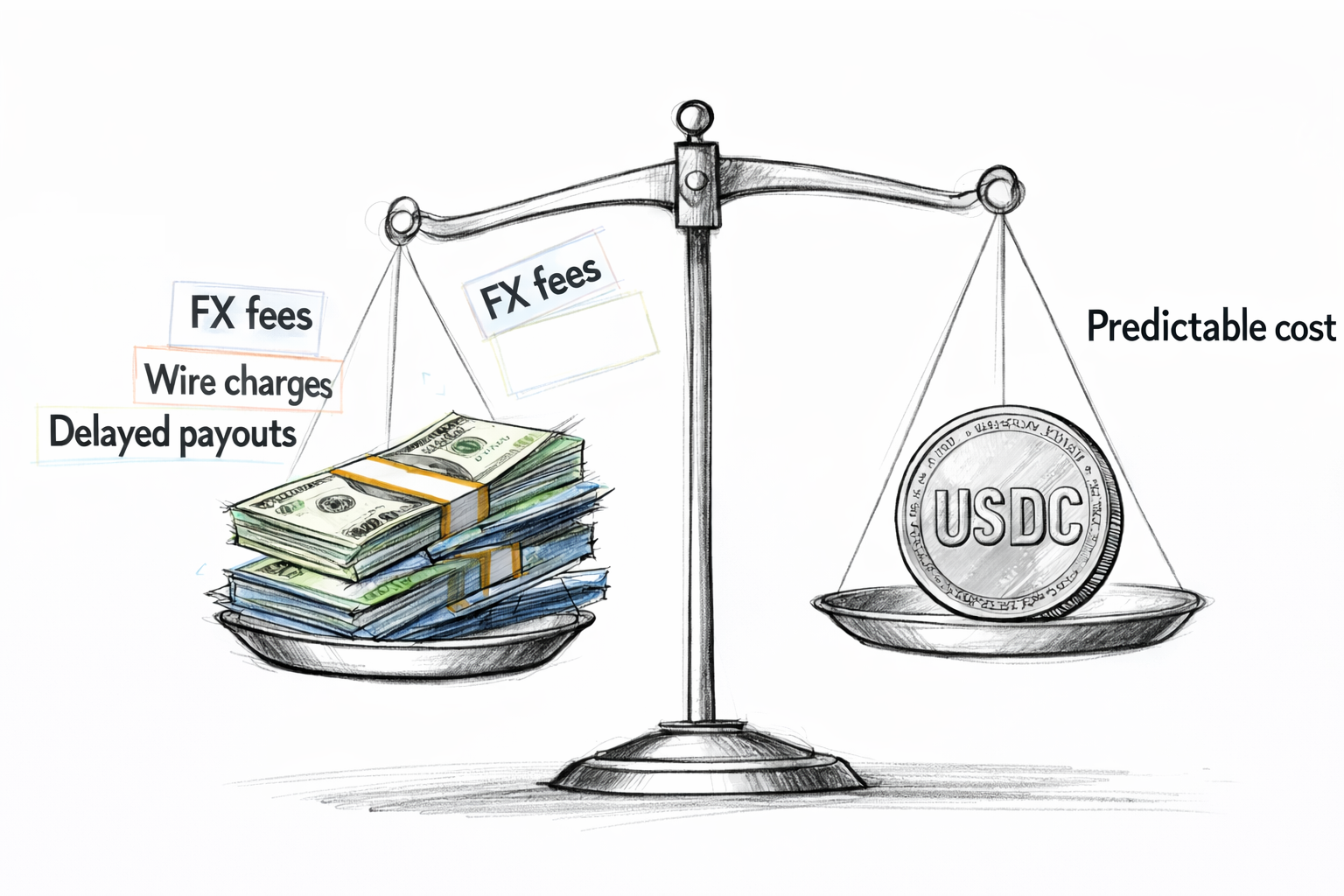
When you’re trying to pick a payment processor, the sticker price, that simple transaction fee, is never the whole story. The real cost of getting paid, especially when you're selling to customers around the world, is buried in things like currency conversion fees, wire charges, and the cash flow crunch from slow payouts. To properly evaluate any Sellhub alternative, you have to dig deeper than the advertised rate and see what it is really going to cost you.
SellHub, and many platforms like it, run on a model where these hidden fees can pile up fast. Say a customer in Germany buys your product in euros. The platform converts that payment to your local currency, but not before skimming a percentage off the top as a foreign exchange (FX) fee. This doesn't just eat into your revenue, it makes your income unpredictable because your final payout swings with the daily market rates.
You end up in a frustrating spot, where the more you sell internationally, the more you’re exposed to these fluctuating costs and settlement delays.
Unpacking the Traditional Cost Structure
The standard way of processing payments has several layers of fees that aren't always transparent. If you're running a global business, you’re likely getting hit with more than just the base transaction rate. Look out for:
- Foreign Exchange (FX) Fees: These are the big ones, usually costing you anywhere from 1% to 3%. They’re charged every single time a customer’s currency gets converted into your own.
- International Payout Fees: Just getting your money across borders can cost you. Wire transfer fees are often tacked on as a flat rate for each payout, shaving even more off your bottom line.
- Opportunity Cost of Held Funds: This is a killer. When your money sits in limbo for days, or even weeks, during settlement, you can't use it. You can't reinvest it, pay your bills, or earn interest on it. That delay has a very real, tangible cost.
As you look for an alternative to SellHub, it's absolutely crucial to compare payment gateways with these hidden costs in mind. You need to find what truly fits your business's financial reality.
The USDC Settlement Advantage
This is where a solution like Suby completely changes the game. By settling every payment in USDC, it sidesteps the entire mess of costs tied to cross-border fiat currency transactions. The model couldn't be simpler: your customers pay with their card, and you receive USDC.
With USDC settlement, there's no currency conversion on your end. That means zero FX fees and zero exposure to volatile exchange rates. Your revenue becomes predictable down to the cent, no matter where your customers are.
This approach gives you a crystal-clear picture of what it actually costs to accept a payment. Instead of navigating a confusing web of variable fees, you have one transparent rate.
Comparing All-Inclusive vs. Tiered Pricing
Suby’s pricing is built for this modern, global reality. Whether you're using shareable paylinks, an embedded checkout, or integrating directly with the API, the model is straightforward. Pricing starts at an all-inclusive 5%, which covers all card processing and settlement costs. There are no hidden charges.
These fees are not only transparent but often end up being much more affordable than traditional platforms once you factor in the eliminated FX spreads and operational headaches. You can find all the information by reviewing Suby's pricing details.
This all-in-one structure brings a level of clarity that’s often missing elsewhere. You can actually forecast your transaction costs accurately without needing a separate line item for international payment issues. For any business serious about growing globally, that kind of financial predictability is a massive competitive edge.
Developer Experience and Integration Options
For any business with a tech team, the developer tools a payment platform offers are not just a feature, they are a make-or-break factor. A clumsy API or confusing documentation does not just slow down a project, it adds a layer of permanent friction to your operations. When you're looking for a SellHub alternative, how smoothly it plugs into your website, app, or custom workflow is everything.
You can tell a lot about a platform by its developer experience. Tools built on top of old-school financial systems often have APIs that feel like an afterthought and lack real flexibility. In contrast, modern platforms are built API-first. That means every feature is designed from the ground up to be controlled through code.
This API-first philosophy is exactly what makes a solution like Suby stand out. It gives developers the raw materials to build precisely what they need, whether that’s a simple payment button or a complex, multi-layered subscription engine.
Comparing API Design and Documentation
A great API feels intuitive and consistent, and it's backed by documentation that's loaded with real-world examples, not just dry technical specs. While SellHub provides some basic API access, it's clearly designed for simpler use cases. If you need fine-grained control over the entire payment flow, you'll likely hit a wall.
Suby, on the other hand, was built with developers in mind, offering a powerful and flexible API that lets any business accept payments by card or crypto. The documentation is clean and thorough, walking you through everything from generating one-time payment links to managing the entire subscription lifecycle with webhooks. This makes it a much stronger SellHub alternative for businesses that live and breathe code.
The real power of a modern payment API isn't just about handling complex logic, it's about delivering simple, predictable results. With Suby, it doesn't matter if a customer pays with a card or crypto; the settlement always lands in your account as a clean, reliable USDC transaction.
This consistency is a huge win for your backend team. Developers do not have to write convoluted logic to juggle different currencies or settlement methods. That saves an incredible amount of time and drastically reduces the chance of bugs.
Practical Implementation Scenarios
The true measure of an API is what you can actually build with it. Suby's flexible toolkit unlocks a whole range of practical applications for businesses of any size.
- No-Code Payment Links: Need something fast? You can generate shareable payment links straight from the dashboard or through the API. It's perfect for sending invoices or selling a single product.
- Custom Checkout Experiences: Use the API to build a checkout flow that looks and feels exactly like your brand, integrating seamlessly into your site or app.
- Automated Subscription Management: Webhooks give you instant, real-time pings on every payment event. This lets you automatically grant, or revoke, access to software, premium content, or other services.
- Community Monetization: Suby also has native integrations for Discord and Telegram, which are fantastic for managing paid access and subscriptions in online communities without writing a single line of code.
This kind of versatility means your payment system can grow with you. As your business evolves, you won't be stuck with an infrastructure that can't keep up. The online payment API market is exploding, projected to hit USD 306.5 million by 2032, and it's precisely this demand for powerful, simple integration that's fueling it. You can see more data on the growth of payment APIs.
For a deeper dive into implementation, take a look at our guide on how to accept crypto payments for your business.
How to Choose the Right SellHub Alternative
Picking the right SellHub alternative boils down to what your business actually needs. Once you've looked at features, pricing, and the developer tools on offer, your final call should sync up with how you plan to grow, especially if you're selling to customers all over the world. This is where a little situational advice goes a long way.
You have got to ask yourself the right questions. Is getting predictable cash flow from international sales your number one headache? Is your business model built on recurring revenue from a global customer base? Or maybe you're trying to monetize a digital community and you're just sick of all the manual admin. Your answers will point you straight to the right platform.
For SaaS and Subscription Businesses
If you're running a SaaS company with customers in different countries, your biggest headaches are probably managing recurring bills across borders and shielding your revenue from currency swings. Your average payment processor usually drops the ball on both counts, making things complicated and unpredictable.
This is a classic use case where a platform like Suby just clicks. Since every single subscription payment settles in USDC, your monthly recurring revenue (MRR) becomes stable and predictable. Your customers pay with their card like they always do, but you get a consistent USDC amount every time. It completely takes the guesswork out of financial planning. On top of that, its powerful API and webhooks let you build deep integrations to automate everything from granting user access to managing churn.
For E-commerce Stores and Digital Creators
E-commerce shops and creators selling digital goods to a global audience run into a very similar problem. You need a simple, bulletproof way to take payments from anyone, anywhere, without watching a chunk of your profit vanish into hidden fees and currency conversion costs. Adding the option to accept both card and crypto payments just opens up your market that much more.
The real win here is a combination of simplicity and reach. A solution that lets customers pay with their cards while you get paid in USDC gives you the best of both worlds: a checkout experience they already know and fast, stable payouts for your business.
This is another area where Suby shines, offering one unified system for both payment types. Whether you're just using a no-code payment link for a digital download or embedding a full checkout on your site, the process is dead simple. This approach means you can stop juggling multiple payment gateways and seriously streamline your operations.
For Monetizing Online Communities
If your business is built around a Discord or Telegram community, you know that managing paid access is often a clunky, manual nightmare. What you really need is a tool that links payments directly to membership roles, putting the entire subscriber lifecycle on autopilot.
The right SellHub alternative for this scenario has to have native integrations that do this for you automatically. Suby was built for this, tying payments directly to your community platform. When a member pays, they get their role instantly. If they cancel or their payment fails, their access is revoked without you having to lift a finger. This frees you up to actually build your community instead of playing gatekeeper. At the end of the day, the best tool is the one that gets out of your way.
Frequently Asked Questions
When you start looking into a SellHub alternative with a modern settlement model, you will probably have a few practical questions. Let's get right into the answers so you can see how it all works.
How Does My Customer Pay If I Receive USDC?
Your customer's checkout experience does not change one bit. They will still pay with their credit or debit card on a secure checkout page, just like they do everywhere else online.
The process happens behind the scenes. The system processes their card payment and settles the funds as USDC in your account, all without them needing to do anything different or even know it's happening.
Is Receiving Payments in USDC Secure?
Absolutely. Getting paid in USDC is a very secure way to manage your revenue. USDC is one of the most established, dollar-backed stablecoins out there, issued by regulated financial institutions in the U.S.
It is built for stability and transparency, so you can count on it for receiving funds from anywhere in the world without the wild price swings you see with other cryptocurrencies.
The real advantage of USDC is its stability. Every USDC is designed to be redeemable 1-for-1 for U.S. dollars. That means you're holding a dependable store of value for your business's hard-earned cash.
What Kind of Businesses Benefit Most from Suby?
Suby is a great fit for any business with customers around the globe that needs fast, predictable cash flow. We see a few groups getting the most out of it:
- SaaS companies that juggle international subscriptions.
- E-commerce stores shipping products to a worldwide audience.
- Digital creators monetizing their content for a global fanbase.
- Online communities that need to manage paid access through platforms like Discord and Telegram.
How Difficult Is It to Integrate Suby?
We designed Suby to be flexible, whether you're a developer or not. You can start taking payments almost instantly with our no-code tools, just create and share a payment link for an invoice or a one-time sale.
For those who want a more custom setup, our simple, well-documented API has you covered. It lets any business build a complete payment system right into their website or app for taking both card and crypto payments.
Ready to modernize your payment stack? With Suby, your customers pay by card, and you get fast, predictable USDC settlements. Get started today and see just how simple global payments can be.


