

Gaspard LEZIN
Patreon vs Substack: Which Is Best for Creators in 2026?
Deciding on Patreon vs Substack? Our 2026 guide compares fees, community tools, and payout models to help you choose the right platform for your business.
So, you're trying to decide between Patreon and Substack. It's the classic creator crossroads: one platform looks like the perfect home for your community, while the other seems custom-built for your content. The truth is, they're both powerful, but they were designed with very different creators in mind.
Picking the right one isn't just about features; it's about matching the platform's core philosophy to your own creative goals. Patreon excels at helping you build a multi-layered community around a wide range of content, while the Substack platform is a streamlined machine for writers looking to start their own publication.
Let's break down how they stack up at a high level.
Patreon vs Substack At a Glance
This table gives a quick snapshot of the fundamental differences. Think of it as your cheat sheet for understanding where each platform shines.
Feature | Patreon | Substack |
|---|---|---|
Primary Use Case | Multimedia content & community hub (videos, podcasts, art) | Paid newsletters & written content |
Monetization Model | Flexible, multi-tiered memberships with different perks | Simple, single-tier paid newsletter subscription |
Community Tools | Built-in posts, polls, member-only content, Discord integration | Discussion threads, "Notes" feature, and reader chat |
Content Ownership | You own your content and your member list | You own your content and your email list |
Discovery Features | Limited; relies on creator's existing audience | Strong recommendation network and leaderboards |
While the table is a great start, the real story is in why they're so different. It all comes down to their foundational philosophies.
Key Philosophical Differences
At their core, the platforms were built to solve two very different problems. Patreon, which launched back in 2013, started as a sort of digital tip jar. It has since blossomed into a full-fledged membership platform where you can offer exclusive access and build a tight-knit community around your work.
Just look at Patreon's homepage.
It’s a vibrant collage of podcasters, musicians, video creators, and visual artists. The message is clear: Patreon is a flexible home for almost any type of creative business that thrives on fan support.
On the other hand, Substack is laser-focused on one thing: helping writers launch and grow their own media empires. Everything about it, from its clean editor to its powerful recommendation engine, is designed to get your words in front of more readers and convert them into paying subscribers.
The user metrics from 2025 really highlight this difference. Substack draws an impressive 125 million monthly visitors, thanks to its discovery network. Patreon, by comparison, has a more intimate base of over 8 million dedicated patrons, but those fans have paid out a staggering $4 billion to creators. This paints a picture of Substack's broad reach versus Patreon's deep, direct financial support. You can explore these growth trends and what they mean for creators in more detail on automateed.com.
How Fees and Payouts Impact Your Bottom Line
When you're choosing between Patreon and Substack, the platform fee is the first number you see, but it's far from the whole story. To really get a handle on your take-home pay, you have to dig into the entire financial picture, including payment processing fees, payout charges, and currency conversion costs that are often buried in the fine print.
These combined costs are what directly chip away at your revenue, and they can be surprisingly different from one platform to the next. Both Patreon and Substack use external payment processors, which means another fee gets skimmed off the top before their platform cut is even taken. For creators with a global audience, it gets even messier with international payout fees and less-than-ideal exchange rates.
Breaking Down the Fees: A Side-by-Side Look
Patreon and Substack both take a significant slice of your earnings, but they go about it differently. Substack keeps it simple with a flat 10% cut of all paid newsletter revenue. On top of that, you'll pay payment processing fees, which are typically around 2.9% + $0.30 per transaction.
Patreon, on the other hand, operates on tiered plans that charge between 8% and 12%. When you add the same processing fees, your total cost can easily climb to 12-18%. If you want the full breakdown of what percent Patreon takes across its plans, it is worth reading before you commit.
Let's put that in real numbers. If you're earning $10,000 a month, you could be paying anywhere from $1,300 to $1,500 in fees on Patreon. On Substack, that same revenue would cost you roughly $1,300. It's a small difference that can really add up over a year.
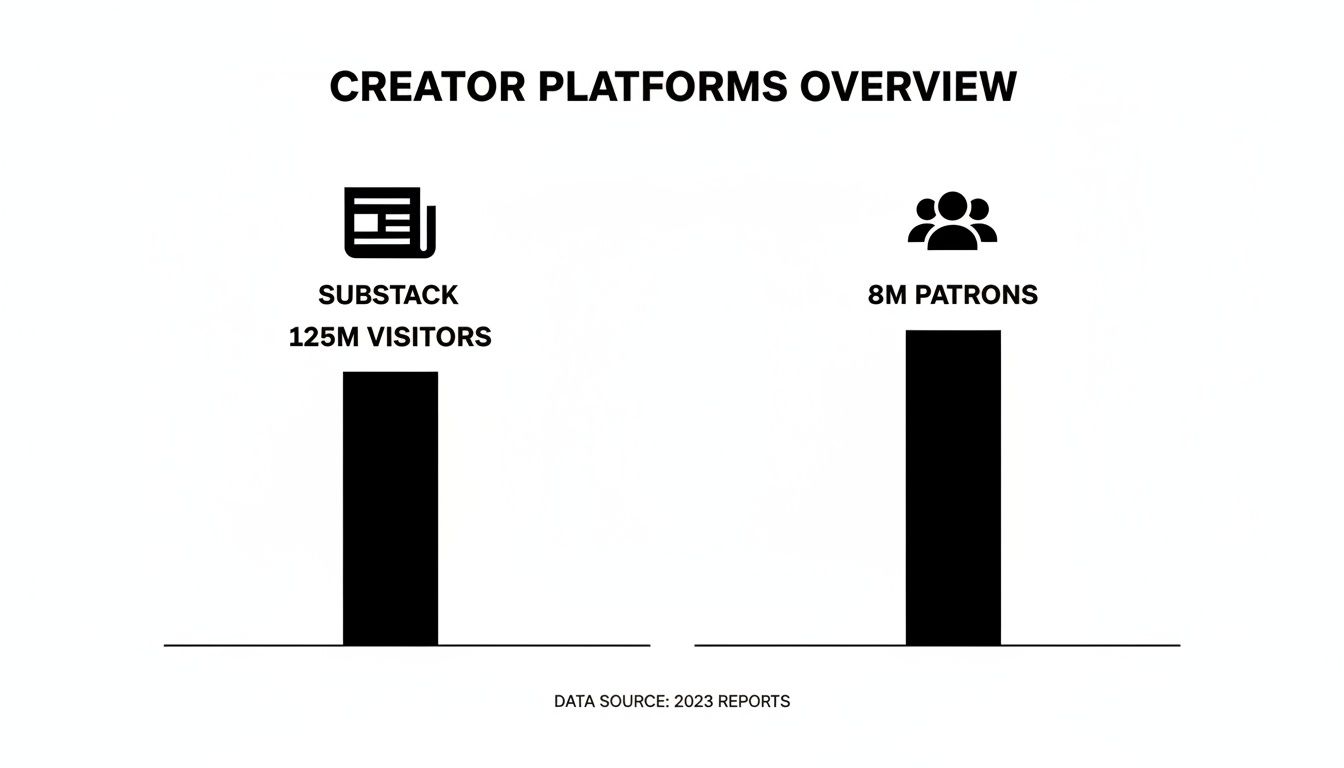
As you can see, Substack's potential for discoverability is massive compared to Patreon's more intimate, closed-community model. This difference in scale not only affects your growth potential but also the kind of fees you might run into as your audience expands globally.
The Hidden Costs of Payouts and Global Transfers
Getting your money out is where another round of costs and frustrations begins. Both platforms have minimum withdrawal amounts and set payout schedules. But for anyone operating outside the U.S., the real pain comes from slow, expensive bank transfers and awful currency exchange rates that can easily shave a few more percentage points off your earnings.
As a creator with a global following, waiting for a SWIFT transfer to clear and then seeing how much you lost on the currency exchange is just deflating. You never know exactly how much you’re going to get, which makes running a predictable business almost impossible.
This is a massive headache that legacy platforms just haven't figured out. Your hard-earned money gets tangled up in an outdated banking system, leaving international creators with unpredictable income and unnecessary stress.
A Modern Approach to Global Payments
What if you could just sidestep that entire maze of stacked fees and slow bank transfers? Modern payment tools are creating a more direct path from your customer’s payment to your pocket, and that's exactly where we come in.
Suby was built to act as a global payment layer that simplifies this entire process for creators and online businesses. Your members and subscribers can pay with their card like they always do, but you receive the funds instantly as USDC right in your own crypto wallet. This model completely removes the need for traditional bank transfers, currency conversions, and all the delays that come with them.
We believe in transparent, all-in-one pricing, which is why our fee starts at a flat 5%. No hidden charges, no surprises.
By seamlessly handling card payments and settling in stablecoins, we eliminate the friction that consistently hurts creators on platforms like Patreon and Substack. If you’re exploring different ways to manage your revenue, you might find our guide on the best subscription billing software helpful.
Membership Tiers vs. Paid Newsletters: What’s Your Model?
How you package and sell your work is the heart of your membership business. This is where the paths of Patreon and Substack really diverge. One gives you a flexible, multi-level playground for building a community, while the other offers a direct, uncluttered path for monetizing written content.
Your choice here isn't just about features; it's about what kind of creator business you want to build. If your model leans toward one-off digital goods rather than recurring memberships, our Payhip vs Gumroad comparison covers a different pair of storefront tools built for exactly that.
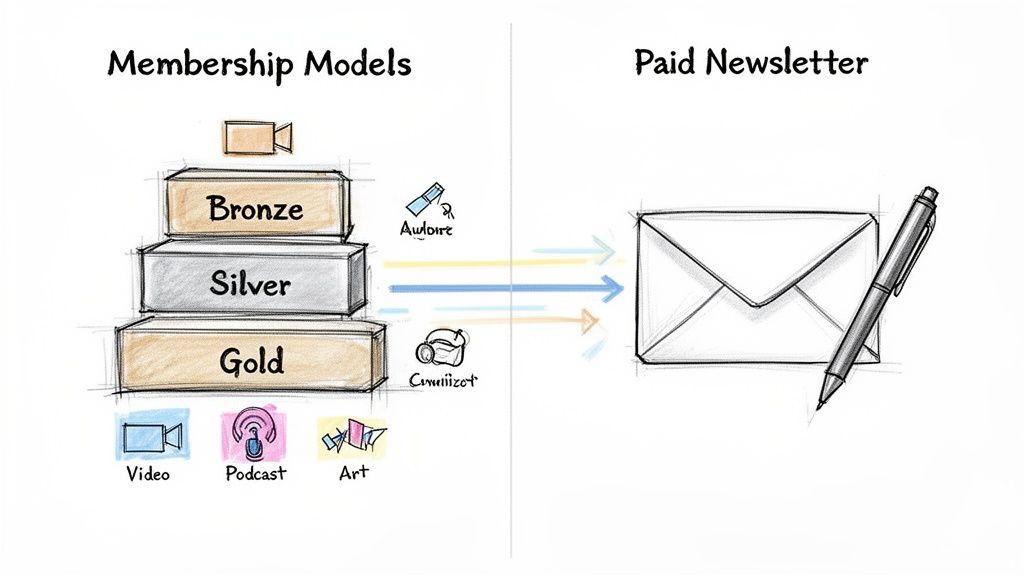
As the illustration shows, the two platforms present a fundamental choice: Are you building a tiered fan club with a variety of perks, or are you delivering a premium publication?
Patreon: The Tiered Membership Hub
Patreon’s core strength has always been its incredibly flexible tier system. It’s built to let you create a value ladder, giving your audience clear reasons to upgrade their support for more exclusive access and benefits.
A classic Patreon structure often looks something like this:
$5/month Tier: Fans get early access to your content and a personal shout-out.
$10/month Tier: Everything from the first tier, plus a monthly bonus podcast or exclusive video.
$25/month Tier: All of the above, plus access to a private Discord community and a monthly Q&A.
This setup is a perfect fit for creators with diverse content formats. Think podcasters dropping bonus episodes, YouTubers sharing behind-the-scenes footage, or musicians releasing exclusive demo tracks. It lets you cater to both casual supporters and die-hard fans under one roof. You can even offer physical merchandise, which makes it one of the more versatile platforms for selling digital products and physical goods.
Substack: The Premium Newsletter, Simplified
Substack champions simplicity. Its model strips away the complexity of tiers and focuses on one thing: turning your words into a paid subscription. You have free readers and you have paying subscribers, that's it. Paying subscribers get the exclusive posts you decide to put behind the paywall.
This elegant, no-fuss approach is Substack's biggest draw. You don't have to juggle multiple benefit packages or create a ton of different perks. The focus is squarely on the quality of your writing. It's a fantastic choice for journalists, industry experts, and analysts who want to cultivate a direct, uncluttered relationship with their readers.
"I think of Patreon as a community-based hub, and Substack as a place which is focussed more on my writing… The reason I have both set up like this is because of the way the platforms are designed—Substack is great for any form of writing, but does not provide good integration for community-led stuff.”
This quote from a creator using both platforms gets right to the point. Are you selling access to a multi-faceted community, or are you selling access to premium content? To see how this choice plays out over time, it’s worth studying different subscription business model examples and how they scale.
Membership and Content Features Compared
Here’s a direct breakdown of how Patreon and Substack handle content and membership features.
Capability | Patreon | Substack |
|---|---|---|
Membership Tiers | Yes, multi-tiered and fully customizable. This is their core feature. | No, just a single paid subscription level. |
"Pay What You Want" | Yes, members can choose to pay more than the tier price. | No, subscription price is fixed. |
Annual Subscriptions | Yes, you can offer discounts for upfront annual payments. | Yes, a core offering alongside monthly plans. |
One-Time "Tips" | No, all revenue is tied to recurring membership pledges. | Yes, via a "Pledges" feature for one-off support. |
Content Paywalls | Yes, you can lock posts by specific membership tiers. | Yes, you can lock posts for paid subscribers only. |
Digital Product Sales | Yes, via the "Commerce" feature for one-time purchases. | No, not a native feature. |
Physical Goods | Yes, can be offered as a tier benefit or through Commerce. | No, not directly supported. |
This table makes the distinction crystal clear. Patreon is a comprehensive membership toolkit, while Substack is a specialized, powerful tool for writers.
While both platforms are great starting points, they do lock you into their ecosystem. If you're building a business that requires more control and flexibility, you might hit a ceiling. With our Suby API, you can design any membership model you can imagine, whether it's tiered, flat-rate, or something totally new. You can accept payments globally via card and get paid out in USDC, all while using our native integrations with Discord and Telegram to manage your paid community automatically.
Evaluating Community Building and Engagement Tools
It’s one thing to get someone to subscribe; it's another thing entirely to make them feel like part of a community. Your long-term success often comes down to this engagement, and it’s an area where Patreon and Substack have very different ideas about what works.
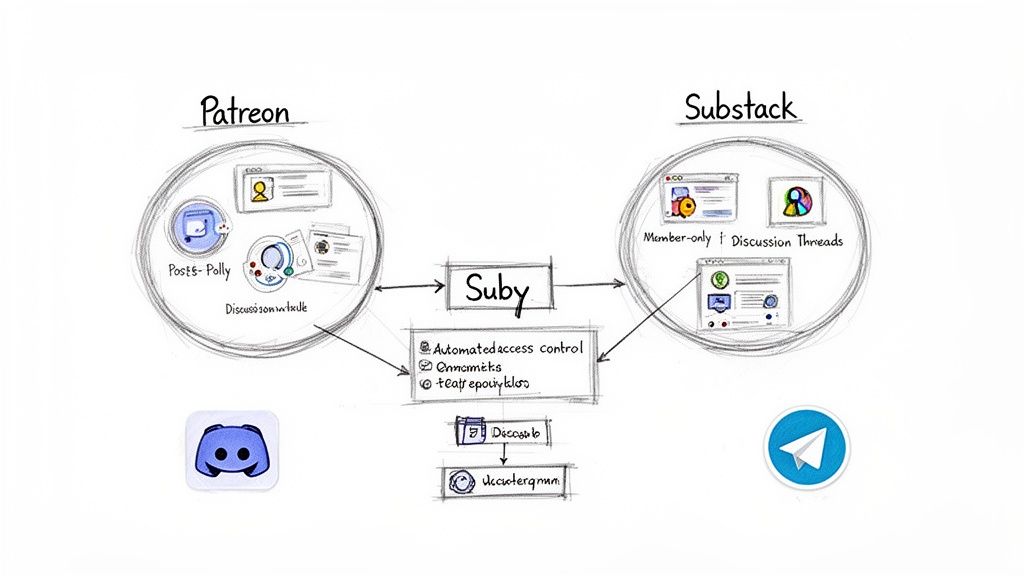
Let's break down how each platform helps you turn passive followers into active members, because the tools they offer will shape the kind of community you can build.
Patreon’s Community-First Approach
From day one, Patreon has positioned itself as a private clubhouse for your biggest fans. The platform's DNA is all about creating a sense of exclusive access and belonging. The goal is to keep your patrons interacting directly with you and each other, right there on the platform.
Here’s what you get in your toolkit:
Member-Only Posts: This is your bread and butter for delivering value. You can lock text, images, videos, and audio files behind specific membership tiers.
Polls and Surveys: These are surprisingly effective. Use them to get feedback, let your patrons decide on your next project, or just make them feel heard.
Native Discord Integration: This is a big one. Patreon can automatically assign roles in your Discord server when someone subscribes, which is a huge time-saver.
That said, the Discord integration isn’t flawless. I’ve seen many creators wrestle with it. If a member's payment fails, they can get kicked from the server, and reconnecting them can be a hassle. For communities with lots of custom roles, it can still require a fair bit of manual cleanup.
Substack’s Writer-Centric Engagement
Substack is a writer's platform, and its community tools reflect that. The engagement features are designed to spark discussion around your content, making the experience feel more like a smart, moderated forum for your readers.
These are your primary tools for interaction:
Discussion Threads: Think of these as dedicated Q&A sessions or topic-based chats that live separately from your newsletter posts. It keeps conversations organized.
Substack Chat: This is a simple, private group chat for your subscribers, accessible only through the Substack app. It’s perfect for sharing quick thoughts, links, or behind-the-scenes updates without sending a full email.
"Notes" Feature: While it’s also meant for discovery, Notes adds a social layer. You can post short-form updates and reshare content, creating a space for writers and readers to interact more casually.
Substack is great for any form of writing, but does not provide good integration for community-led stuff.
This creator’s take sums it up perfectly. Substack is fantastic for fostering conversations about your writing. But if your main product is a standalone community on a platform like Discord or Telegram, Substack leaves you to fend for yourself.
The Challenge of Monetizing External Communities
This is where the rubber meets the road. If your business is a paid Discord or Telegram group, you’ll quickly hit a wall with both platforms.
Patreon’s integration gets you part of the way there, but it keeps you tied to their fees and payment system. Substack provides no native tools at all, which means you’re stuck manually adding and booting members as they subscribe or cancel. That’s a nightmare to manage and simply doesn't scale.
This is exactly why having a flexible, independent payment layer is so important. For example, our own native integrations with Discord and Telegram were built to solve this headache. When a user pays, they get access. When their subscription lapses, their access is revoked. Simple.
This approach lets you separate your payment processor from your community platform. You can run your business on your own terms, without being boxed in by a single platform's limitations. We offer an API so any business can accept card or crypto payments, but our dedicated Discord and Telegram integrations are a no-code solution for community managers. Customers can pay with their card, and you receive stable, predictable USDC payouts. You can learn more about how Suby unifies payments and automatic access control on our website.
Developer Tools and API Flexibility
For most creators just starting out, the built-in features on Patreon and Substack are plenty. But if you're a business with plans to scale, build a custom user experience, or weave payments into your own products, this is where the platforms really diverge. Their approach to developer tools and API access reveals whether they're an open tool for growth or a closed ecosystem.
From a developer’s point of view, both Patreon and Substack are designed to keep you inside their walls. This makes life simple for solo creators, but it can be a serious bottleneck for a business that needs more control.
Patreon’s Limited API Access
On paper, Patreon has an API, which is a start. It lets you pull data about your campaign, your members, and their pledges. You could use this to sync your member list with an external CRM or build a custom dashboard to visualize your earnings.
In practice, though, the API is quite restricted. It's built primarily for retrieving data, not acting on it. For example, you can get a list of your patrons, but you can't use the API to programmatically create new membership tiers or embed a fully custom checkout on your own site. This makes it a tough sell for businesses that want to build a truly integrated membership system.
Substack’s Walled Garden
Substack is even more of a closed system, and that's by design. There is virtually no public API to speak of. The whole experience is centered on the beautiful simplicity of the newsletter format, and custom integrations just aren't part of the picture.
This "walled garden" approach makes Substack incredibly easy to get started with, but it offers almost zero flexibility. You can't programmatically manage your subscriber list, integrate its payment system into your own app, or use webhooks to trigger an automation when someone subscribes. If you need to do anything beyond what Substack offers out of the box, you’re going to hit a wall. Fast.
For any business that needs to connect its payment system to other software, like a course platform, a community app, or a proprietary tool, the lack of a real API is a deal-breaker. You are locked into the platform’s features with no room to build or innovate.
The Power of a Developer-First Payment Layer
This is exactly why developer-centric payment solutions exist. Instead of being locked into a platform's limitations, a flexible API gives you the freedom to build exactly what your business needs. We built our platform with this exact problem in mind.
Suby is a global payment layer designed for online businesses and creators, combining card and crypto acceptance with fast, predictable USDC settlements. You can create shareable paylinks, embed a conversion-optimized checkout, or integrate Suby directly via a simple API and webhooks. The platform supports both one-time payments and recurring subscriptions. You can check out the official Suby documentation to see how it works.
This approach gives you ultimate control. With our robust API, you can:
Programmatically create and manage subscriptions for your own SaaS application.
Embed a seamless checkout flow directly onto your website or landing page.
Use webhooks to instantly grant access to digital content or a private community upon payment.
Accept both card and crypto payments with instant settlement in USDC.
If you see payments as a core piece of your technical infrastructure, this level of control isn't just a nice-to-have; it's essential. It lets you build a custom solution that fits your business perfectly, all while using a global payment system where your customers can pay by card and you get settled in stable USDC.
Which Platform Should You Choose?
So, after digging into all the fees, features, and community tools, how do you actually decide between Patreon and Substack? There's no single right answer, but there is a best fit for your specific work.
It really boils down to one question: are you building a multifaceted fan club, or are you focused on delivering a premium written product? Your answer will almost always point you in the right direction.
For Multimedia Creators and Community Builders
If you’re a podcaster, musician, video creator, or visual artist, Patreon is almost certainly your best bet. Its biggest strength is the flexible, multi-tiered membership system. You can create a value ladder, offering different perks at various price points to appeal to everyone from casual supporters to your most die-hard fans.
This model is built for creators who want to offer a mix of content and rewards, such as:
Bonus video or audio episodes for top-tier members.
Early access to your main content releases.
Physical merchandise or digital downloads as a special perk.
Exclusive access to a private Discord community.
Think of Patreon as a central hub where your audience can gather and get more of what they love. It’s a powerful tool for building a community and monetizing that connection.
For Writers and Journalists
On the other hand, if you're a writer, journalist, or expert whose main craft is the written word, Substack is purpose-built for you. The platform’s beauty is in its simplicity. It’s a finely tuned machine for creating, distributing, and monetizing a newsletter, stripping away all the extra complexity to focus on a single, compelling subscription.
Substack is where you go when your goal is to:
Establish yourself as a thought leader in a specific niche.
Build a direct, personal relationship with your readers.
Get discovered through a powerful network of other writers and publications.
The entire experience is designed to help your writing find its audience and turn loyal readers into paying subscribers with as little friction as possible.
For Global Businesses and Developers
But what if your needs don't neatly fit into either of those boxes? For developers, international businesses, or community managers who need more flexibility, a dedicated payment solution is often the smarter path.
When your business model relies on custom integrations, global reach, or monetizing standalone communities on platforms like Discord and Telegram, you need a solution that isn't locked into a single ecosystem. This is where the limitations of both Patreon and Substack become a significant bottleneck.
This is exactly the problem we built our platform to solve. Suby gives you an API and native integrations to accept payments from a global audience without the usual headaches. Customers can pay with their card. No matter how they pay, you receive the revenue directly in USDC to your wallet, bypassing bank delays and high conversion fees. You can learn more about our global payment solutions and see how they can support your business.
For a direct comparison with Patreon, you can also explore our detailed breakdown in the article, Patreon vs Suby.
Frequently Asked Questions
When you're deep in the weeds comparing Patreon and Substack, a few common questions always seem to pop up. Let's get you some straight answers based on real-world experience.
Can I Use Both Patreon and Substack?
Absolutely, and many creators do. The key is to have a crystal-clear strategy so you don't confuse your audience or burn yourself out.
A common approach is to use Substack for your public-facing work, like a polished newsletter, and treat Patreon as the exclusive, behind-the-scenes community for your true fans. The real trick is managing the workload. You're essentially running two different membership programs, which means double the content and community management. If you have the time and a clear purpose for each, it can work beautifully.
Is It Difficult to Migrate from One Platform to Another?
The technical part is actually the easy part. Both platforms let you export your member lists, which is your starting point. Substack, in particular, makes importing an email list fairly simple.
The real hurdle is the human element. You have to convince your paying supporters to follow you to a new platform, pull out their credit cards again, and get used to a new layout. Be prepared for some members to drop off, it's just part of the process. A successful move hinges on clear communication and giving your community a compelling reason for the switch.
What Is a Better Alternative for Global Payouts and Lower Fees?
If you're frustrated by high platform fees, slow international bank transfers, or waiting on payouts, it's probably time to look past both Patreon and Substack. Honestly, these legacy platforms just weren't designed for a truly global creator business.
This is exactly why modern payment tools have become so essential. For example, Suby was built from the ground up to fix these issues. We offer a flexible API and plug-and-play integrations for Discord and Telegram, so you can build whatever kind of membership you want. Your audience pays with their card like usual, but you get paid out instantly in USDC right to your own crypto wallet. It completely bypasses the slow, expensive world of bank transfers and currency conversion.
You get more control, predictable cash flow, and keep more of your money. It's that simple.
Suby is a payment gateway and payment processor. Your customers pay with card, bank transfer, Apple Pay, Google Pay, Klarna, and more, or stablecoins, and you get paid out to your bank account, or directly in stablecoins (USDC, EURC) to your wallet. Anywhere in the world, no bank account required. For creators, that means you can build any membership model you want and keep your Discord or Telegram community, without the high fees, slow bank transfers, and currency conversion that hold you back on Patreon and Substack. Get started with Suby today and take control of your revenue.
