

Gaspard LEZIN
Finding the Best Whop Alternative for Global Monetization
Searching for a Whop alternative? This guide compares top platforms for creators, focusing on global payments, fees, and instant USDC payouts.
If you're selling digital products or running an online community, picking the right platform to handle your money is a make-or-break decision. Whop is a familiar name in the space, but a growing number of creators and global businesses are actively looking for a Whop alternative. They're hitting a wall with modern problems like cross-border payments and payout friction.
For businesses serving an international audience, the need for more flexibility than what traditional platforms offer is becoming crystal clear.
Why Businesses Are Looking for a Whop Alternative
As digital commerce erases borders, the cracks in conventional payment systems are starting to show. Whop has certainly proven itself a solid tool for many, but its deep roots in traditional banking infrastructure can create major operational headaches for anyone with a global customer base. This friction is pushing many to find a Whop alternative that's built for the way the internet actually works.
The biggest sticking points almost always circle back to payments and payouts. When a customer in Europe or Asia buys from a US-based seller, that single transaction has to snake its way through a maze of currency conversions, international banking rules, and different regional payment processors.
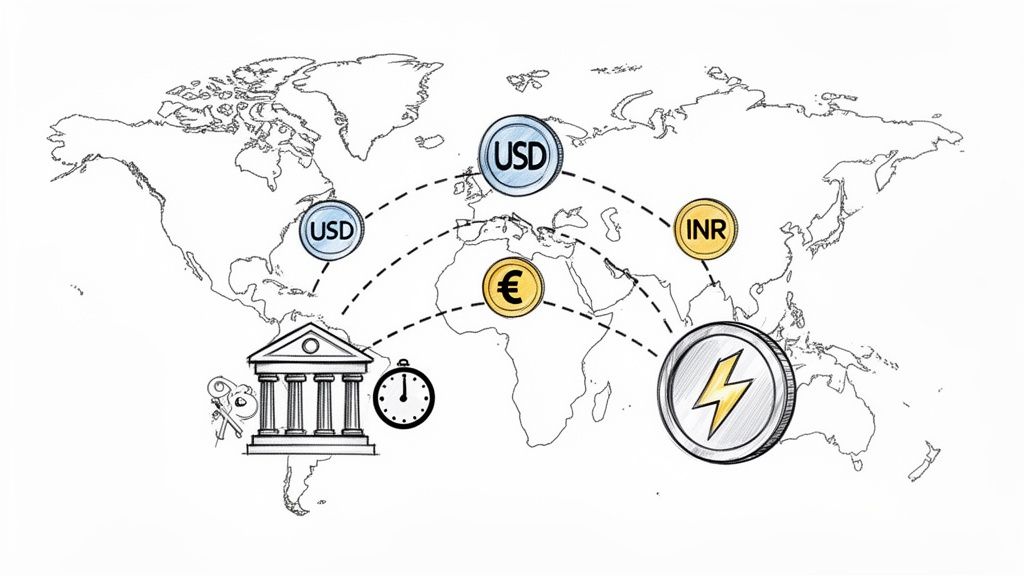
This process is what creates the pain points that send businesses searching for a better way.
The Problem with Traditional Payouts
One of the most frustrating challenges is simply not knowing when you'll get your money. Old-school systems often come with multi-day settlement periods, and international transfers have a knack for getting lost in a tangle of correspondent banking networks. For a small business or a solo creator, waiting days or even weeks for revenue to land can seriously disrupt cash flow and stop growth in its tracks.
The real cost of global sales isn't just the sticker price of fees, it's the operational drag from slow, unpredictable payouts and the manual effort spent managing different currencies.
On top of that, currency conversion adds another layer of messy complexity. You don't just lose a slice of your revenue to foreign exchange (FX) fees, you're also exposed to the whims of currency fluctuations. The amount you think you're getting can shrink between the sale and the payout, which makes trying to plan your finances feel like guesswork. It’s no wonder people are demanding a more direct solution.
Key Reasons Businesses Seek Alternatives
The hunt for a Whop alternative usually comes down to a handful of core business needs that platforms tied to legacy financial rails just don't solve well enough.
Global Payment Friction: Sellers need to offer a smooth checkout for everyone, no matter where they live. High decline rates on international cards or a lack of local payment methods are just lost sales waiting to happen.
High and Hidden Fees: It’s not just the standard transaction fees. Businesses often get hit with another 3-5% in hidden costs from currency conversion and international bank wires.
Payout Delays and Uncertainty: Being at the mercy of the banking system means your revenue is vulnerable to holds, delays, and red tape, creating a constant state of cash flow anxiety.
Operational Complexity: Juggling payouts in multiple currencies creates a mountain of administrative work, demanding extra time for accounting and reconciliation.
Many businesses looking for an alternative to Whop also check out other platforms designed to simplify selling digital products, like the Lemon Squeezy platform, and crypto-first options such as a MoonPay Commerce alternative. Ultimately, the goal is to find a solution that gets rid of these headaches so they can focus on what actually matters, their products and their customers, instead of logistics.
A Detailed Comparison of Whop and Suby
Picking the right platform for your business often boils down to the nitty-gritty of how they handle your money, especially when your customers are all over the world. While Whop has certainly made a name for itself, putting it side-by-side with an emerging Whop alternative like Suby shows two fundamentally different ways of thinking about modern commerce.
For anyone selling internationally, these differences aren't just minor details. They can seriously affect your revenue, how quickly you get paid, and how much administrative headache you have to deal with. Suby was built from the ground up to solve the cross-border payment friction that plagues so many businesses, mixing familiar payment methods for customers with a much more efficient settlement system for sellers.
Core Philosophy and Target Audience
Whop generally caters to creators and communities that fit neatly into the traditional e-commerce world. Its system is straightforward, it connects with standard payment processors and drops funds into your bank account. This is a solid model if most of your customers are in your home country and you aren't constantly wrestling with international banking issues.
Suby, however, is built for the global, internet-native business. Its entire philosophy is that a seller in one country should be able to sell to a customer in any other country without getting bogged down by slow banks and surprise fees. This makes it a great Whop alternative for SaaS founders, developers, and digital creators whose customer base is as borderless as the internet itself.
Payment and Payout Systems
The biggest difference between the two is how your money moves from point A to point B. With Whop, you're using conventional payment rails. A customer's credit card payment has to travel through multiple intermediaries before it finally shows up in your bank account, which can take several days and often involves currency conversion fees.
Suby takes a completely different route. Customers can pay with their card or crypto, but you, the business owner, always receive the funds as USDC directly in your digital wallet. This process sidesteps the old-school banking system entirely, leading to nearly instant settlement without the usual delays or hidden cross-border charges.
The real choice between these platforms is whether you prefer your revenue to travel through the old banking system or the new digital one. One is slow and complex, the other is fast and direct.
To really see how they differ, let's break down the core features.
Platform Comparison Whop vs Suby
This table gets right to the point, highlighting the fundamental differences in how each platform manages payments, settlement, and global reach.
.tbl-scroll{contain:inline-size;overflow-x:auto;-webkit-overflow-scrolling:touch}.tbl-scroll table{min-width:600px;width:100%;border-collapse:collapse;margin-bottom:20px}.tbl-scroll th{border:1px solid #ddd;padding:8px;text-align:left;background-color:#f2f2f2;white-space:nowrap}.tbl-scroll td{border:1px solid #ddd;padding:8px;text-align:left}FeatureWhopSubyCustomer PaymentsPrimarily Card PaymentsCard Payments and Crypto OptionsSettlement CurrencyLocal Currency (e.g., USD, EUR)USDC (Stablecoin)Payout MethodBank TransferDirect to Crypto WalletPayout SpeedSeveral Business DaysNear-InstantGlobal ReachGood, but subject to banking limitsTruly Global, no bank requiredCurrency Conversion FeesYes, for international salesNone, settles in USDCDiscord/Telegram AccessYes, core featureYes, native integrationDeveloper APIAvailableYes, simple and powerful API
This comparison makes the core distinction crystal clear. If your business depends on speed, global accessibility, and predictable cash flow without worrying about currency fluctuations, Suby’s flexible settlement (bank payout, or stablecoins (USDC, EURC) to your wallet) offers a major advantage.
For an even more in-depth analysis, check out our detailed Whop vs Suby comparison. In the end, the right platform really depends on a simple question: is your business built for a local market or for the borderless internet?
How Each Platform Handles Payments and Payouts
Let’s get down to what really matters: how you get paid. A slick payment process for your customers is table stakes, but the real make-or-break feature is the payout system. This is where a platform like Whop, which follows a more traditional path, and a modern Whop alternative like Suby really start to look different. The choice you make here will directly affect your cash flow, your fees, and ultimately, your bottom line.
For any online business, the nuts and bolts of moving money define your day-to-day reality. Slow transfers, hidden fees, and the headache of currency conversions can turn a great sales month into a bookkeeping nightmare. So, let's break down how each platform handles this critical piece of the puzzle.
Whop’s Traditional Payment and Payout Model
Whop runs on a familiar, bank-based system. Customers pay with their credit or debit card, and the money gets routed through the traditional payment networks. After a few days of processing, the funds land in your connected bank account, converted to your local currency.
This setup is perfectly fine if you're only selling to people in your own country. But the cracks start to show the moment you go global.
SWIFT Delays: International bank transfers are often stuck in the SWIFT network, which can mean waiting several business days for your money. That’s a significant lag between making a sale and actually having the cash on hand.
Foreign Exchange (FX) Fees: When a customer pays in another currency, someone has to convert it. That process almost always comes with foreign exchange fees that can skim 3-5% right off the top of each transaction.
Payout Holds and Uncertainty: Traditional payment processors are notorious for compliance checks and fraud reviews that can lead to sudden, unexpected holds on your money. This unpredictability makes it tough to plan your finances when you need reliable income.
A key part of choosing a platform is understanding the best payment processing software solutions available, and for Whop users, this means getting comfortable with the old-school banking world.
Suby’s Unified Card and Crypto Payout System
Suby takes a completely different approach by building a bridge between traditional payments and crypto, sidestepping the old banking rails altogether. It creates a single, clean process where what your customer uses to pay is totally separate from how you receive your money.
It’s refreshingly simple. Your customers can pay with a standard card (Visa, Mastercard, you name it) or with crypto. No matter which they choose, you get paid instantly in USDC to your own digital wallet.
This flow diagram shows just how direct Suby’s model is, turning a standard card payment into instant stablecoin in your wallet.
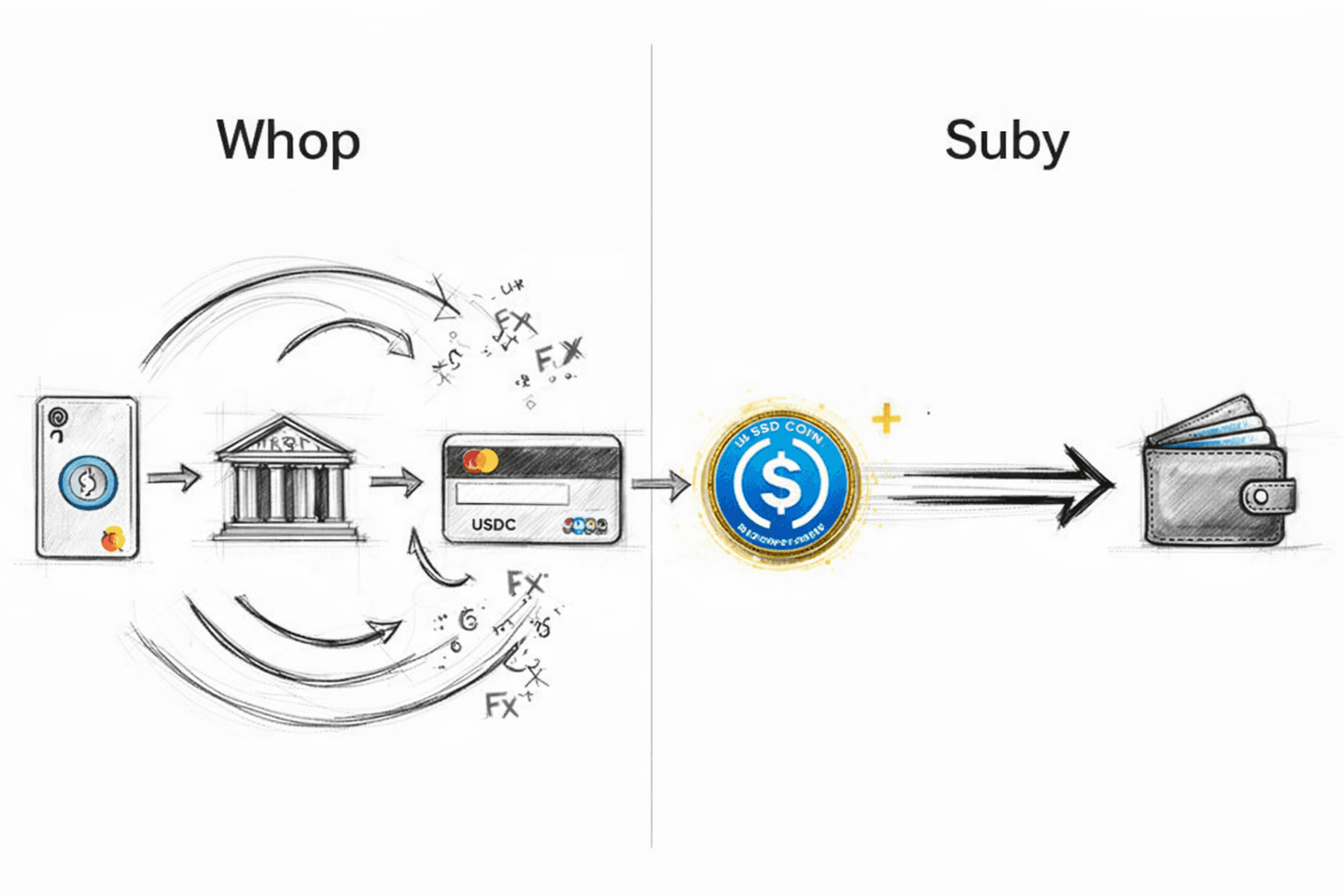
This method cuts out the biggest headaches of global commerce, positioning Suby as a seriously effective Whop alternative for businesses born on the internet.
The real magic of USDC settlement is predictability. Your money arrives instantly, its value doesn't fluctuate wildly, and it's completely free from the delays, fees, and friction of the cross-border banking system.
And the scale of this problem is huge. The global cross-border payments market was valued at around $194.6 trillion in 2024 and is projected to hit $320 trillion by 2032. This explosive growth is exactly why businesses are desperate for modern solutions that don’t rely on decades-old banking infrastructure.
Comparing the Real-World Impact
Let’s put this into a real-world context. Imagine you’re running a community from the US with members paying you from Europe and Southeast Asia.
On Whop, every international subscription would get hit with a currency conversion. You'd lose a slice to FX fees and then have to wait a few days for the money to crawl through the banking system before it finally lands in your USD account.
With Suby, that same transaction is a world apart. Your international members pay in their local currency using their card. You instantly receive the full value in USDC, no conversion fees, no waiting. This is a game-changer for anyone figuring out https://www.suby.fi/post/how-to-accept-international-payments without the usual pain. Your revenue becomes just as global as your customer base, letting you manage your finances in real-time.
Breaking Down Fees, Security, and Compliance
When you're picking a platform to build your business on, cool features are only part of the equation. You absolutely have to dig into the fine print on the financial and security side of things. The fee structure, compliance standards, and security protocols can make or break your profitability and, just as importantly, your customers' trust.
What looks like a tiny percentage point difference in fees can add up fast. And a slip-up in security? That's a business-killer. This is one area where you'll see some of the starkest contrasts between a traditional platform and a modern Whop alternative. Getting this right is critical, especially if you have customers all over the world.
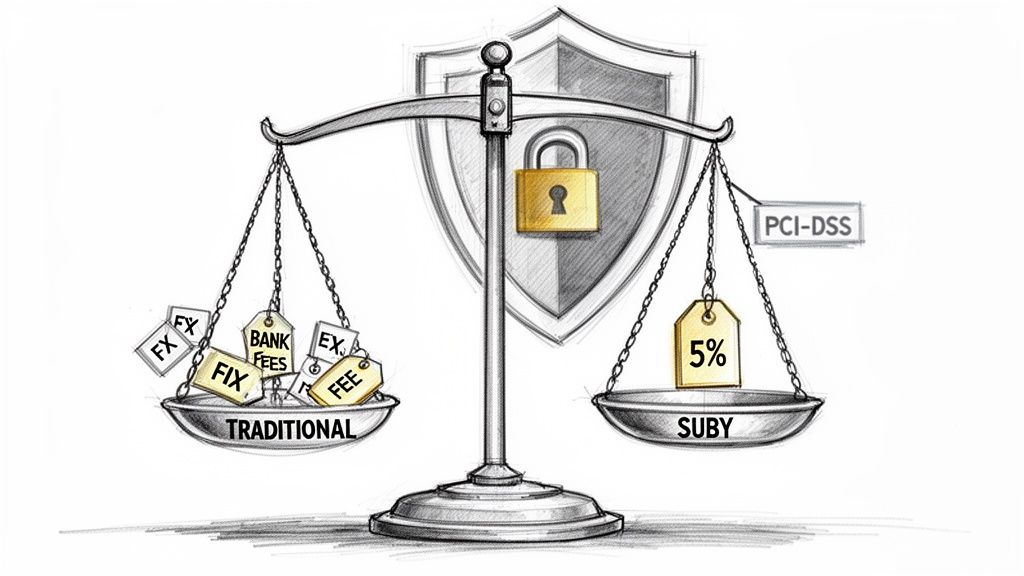
Let’s really get into how Whop and Suby stack up on these make-or-break details.
Understanding Whop's Fee Structure
At a glance, Whop's pricing looks simple enough. But because it's built on the old-school banking system, hidden costs have a way of creeping in, especially when you start selling internationally. That base fee they advertise is really just the beginning. The moment you sell to someone outside your country, you're suddenly dealing with currency conversion spreads and international bank transfer fees.
These costs often stack up and can be a real headache to predict:
Base Transaction Fee: This is the standard cut they take from every sale.
Currency Conversion Fees: When your customer pays in their local currency, the bank or payment processor tacks on a fee to convert it, which can easily be 2-4% of the total.
International Payout Fees: Just moving your money from one country to another via a bank transfer can trigger more fees, either flat-rate or another percentage.
If you have a global customer base, these fees can seriously chew into your margins, and the same math applies when you compare a SellHub alternative for card payments and USDC payouts. It makes it nearly impossible to know exactly how much cash you'll actually pocket from each sale.
Suby's Transparent, Pay-As-You-Go Pricing
Suby cuts through all that complexity with pay-as-you-go pricing and no plans or monthly fees. You pay one flat rate per payment category: 2.9% + $0.30 on cards and wallets, 1.5% on crypto, and 1% + $1 on bank transfers. Because the platform settles every payment in USDC, it sidesteps the convoluted parts of the traditional system where all those extra costs are born.
By settling directly in USDC, Suby eliminates the unpredictable and often hidden costs of foreign exchange and international banking. You get exactly what's advertised: predictable per-category rates with no FX surprises.
This approach is a game-changer for businesses with global ambitions. A creator in Asia can sell to a customer in Europe as seamlessly as if they were in the same city. It makes your financial planning a whole lot easier and lets you keep more of the revenue you worked so hard to earn.
Security and Compliance Standards
When you're handling payments, security isn't just a feature, it's a foundation. Your customers need to feel confident that their financial data is locked down, and you need to know your platform meets the highest industry standards.
Both platforms take this seriously, but their core infrastructure shapes their approach. Whop works with established payment processors that follow standard security protocols.
Suby, on the other hand, provides rock-solid security by partnering with a PCI-DSS Level 1 certified processor, the gold standard for protecting card data. This guarantees that every transaction is shielded by the best security measures in the industry. If you want to dive deeper, we have a guide explaining what is PCI-DSS compliance and why it's so crucial.
On top of that, Suby layers in other essential security features:
Strong Customer Authentication (SCA): A key requirement for European transactions that adds another security checkpoint to stamp out fraud.
Built-in Protections: Things like two-factor authentication and secure checkout flows come standard, protecting both your account and your customers.
By giving customers a familiar and secure card payment experience while giving businesses the speed and efficiency of USDC settlements, Suby proves that a modern payment model can deliver top-tier security without the baggage of the old system. This makes it a powerful Whop alternative for any business that refuses to compromise on either cost or security.
Community and Developer Integrations: Where the Rubber Meets the Road
A payment button is just the start. The real power of a monetization platform lies in how deeply it connects with your business, whether that's an online community or a custom-built application. A great system should feel invisible, automating the grunt work and giving developers the freedom to build. This is often where a modern Whop alternative can really shine, catering to both community managers and coders.
For community-focused businesses, it’s all about automating access based on who's paid up. For developers, it's about getting a clean, flexible API to build whatever they can dream up. Let’s see how Whop and Suby stack up for these two critical groups.
Native Integrations for Online Communities
So many of today’s most exciting businesses are built around communities on Discord and Telegram. For them, the ability to automatically grant, and just as importantly, revoke, access to private channels when a subscription starts or ends isn't just a feature, it's essential.
Whop has this down pat. It's a core part of their offering for creators, and they do a solid job managing member roles to make sure paying subscribers get what they paid for.
Suby delivers the same must-have functionality with a completely different engine under the hood. It offers native integrations with both Discord and Telegram, but because every payment settles instantly as USDC, the signal to grant or revoke access is immediate. There's no lag time waiting for a bank payment to clear before a new member can jump into your server.
This kind of automation is a massive time-saver for any community manager. Instead of manually cross-referencing payments and assigning roles, you can get back to what you do best: building a great community.
API Flexibility for Developers
While community integrations are a huge piece of the puzzle, a platform's API is what reveals its true potential. This is where businesses graduate from simple monetization to building sophisticated, custom payment flows right into their own apps, from SaaS platforms to e-commerce sites.
Whop offers an API that lets developers tap into its system. However, for businesses that need a truly global payment layer, the API can feel held back by the traditional banking rails it's built on.
Suby, on the other hand, was built API-first from the ground up. It provides a simple, powerful API that lets any business accept payments by card or crypto, with every single transaction settling in USDC. This architecture makes it an incredibly versatile tool for developers.
For a developer, a great API solves a complex problem with simple, clean code. Suby’s API abstracts away the chaos of global payments, giving you a single endpoint for card and crypto acceptance with instant USDC settlement.
This snapshot from Suby's developer documentation shows just how focused they are on a clean, straightforward experience for developers.
The documentation is direct and gets straight to the point, helping developers plug in a global payment solution without a frustratingly steep learning curve.
The implications here are massive. Cross-border payments are on track to hit $250 trillion by 2027, yet they're often painfully slow and expensive compared to domestic ones. This gap is exactly why businesses are hunting for a Whop alternative that uses stablecoins to make global transactions frictionless. Suby is built for this reality, ensuring merchants get USDC payouts whether customers pay with cards or crypto. This completely sidesteps SWIFT delays and foreign exchange fees. You can dig deeper into the challenges in the cross-border payment landscape on aciworldwide.com.
Building Custom Solutions
Suby's toolkit for developers goes beyond just a standard REST API, offering components designed to make integration fast and painless for any use case.
Embeddable Checkouts: You can drop a pre-built, conversion-optimized checkout form right onto your website. It gives you a custom feel without having to build the whole payment flow yourself.
Webhooks: Get instant notifications for key events like successful payments, new subscriptions, or cancellations. This lets you build powerful automations, like instantly unlocking a feature in your SaaS product the moment a payment goes through.
Shareable Payment Links: For businesses that don't need a deep API integration, you can spin up a simple payment link in seconds. It’s perfect for agencies, freelancers, or anyone needing to collect a one-off payment or start a subscription on the fly.
When you zoom out, Suby’s approach positions it as more than just a creator tool, it’s foundational payment infrastructure. It’s built for any internet-native business, from a SaaS company chasing global subscribers to an e-commerce store with customers on every continent.
Choosing the Right Platform for Your Business
Picking the right platform isn't about finding a one-size-fits-all winner. It’s about finding the perfect fit for your specific business. The best Whop alternative for you hinges on who your customers are, how you operate, and where you plan to grow. If you want a wider field to compare, this roundup of the top Whop alternative platforms for 2026 is a useful starting point. Once you’re clear on your priorities, the right choice usually becomes obvious.
For instance, if your customer base is almost entirely in one country, a platform like Whop can get the job done. Its traditional, bank-based payment system handles domestic transactions just fine, and you won’t run into the friction that comes with cross-border payments.
But the second your business starts attracting an international audience, the calculation changes completely.
A Framework for Your Decision
This simple decision tree can help you visualize which path makes the most sense for your business right now.
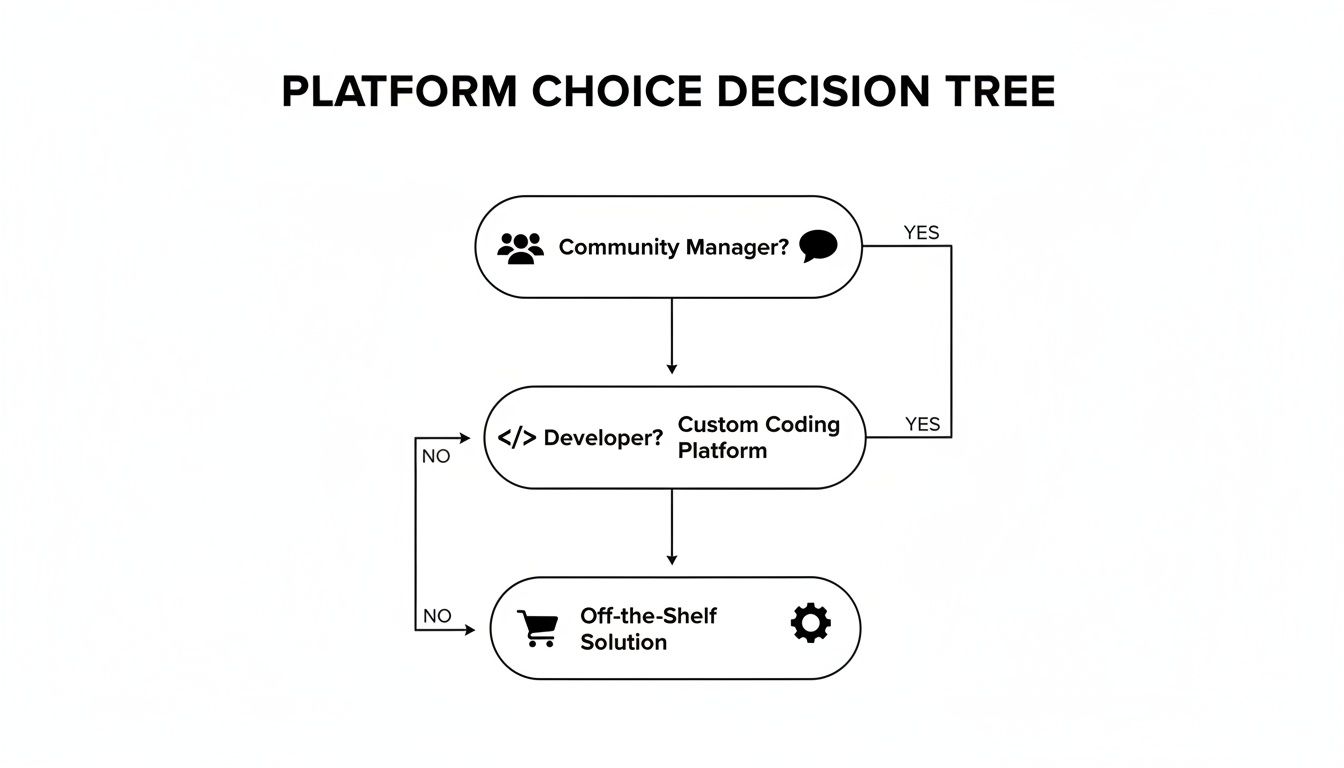
As the graphic shows, both community managers and developers have modern tools built for their unique workflows. The old "one-size-fits-all" approach just doesn't cut it anymore.
For any business with a global footprint, choosing a Whop alternative like Suby isn’t just a convenience, it’s a strategic move. This applies to a whole range of businesses:
SaaS companies selling subscriptions to a worldwide user base.
E-commerce stores shipping products to international customers.
Agencies and freelancers who invoice clients across different countries.
Creators cultivating diverse communities on platforms like Discord and Telegram.
The decision really boils down to this: if your business lives on the internet and operates without borders, you need a payment system that does the same.
For these kinds of businesses, being able to accept standard card payments while getting instant, stable USDC settlements isn't just a nice feature, it's essential. It sidesteps the delays, hidden fees, and administrative nightmares that come with the old-school banking system. By bringing card and crypto payments into one seamless flow with predictable USDC payouts, Suby delivers a payment infrastructure built for the speed and scale of a truly global business.
Frequently Asked Questions
When you're thinking about moving away from a platform like Whop, you're bound to have questions. It's a big decision. Let's tackle a couple of the most common ones that come up when people are exploring alternatives like Suby.
Can I Still Take Normal Credit Card Payments with an Alternative Like Suby?
Yes, of course. From your customer's perspective, nothing changes. They'll see a clean, secure checkout page where they can pop in their Visa or Mastercard details, just like they would anywhere else online.
The real magic happens behind the scenes, for you. Instead of waiting days for a bank transfer to clear, the funds land in your crypto wallet as USDC almost instantly. It’s the familiar, easy experience your customers expect, but with the modern, efficient payouts your business needs.
How Hard Is It to Actually Move from Whop to Suby?
We get it, "migration" can sound like a headache, but this is designed to be as painless as possible. You can get going in minutes by creating simple payment links to share anywhere. If you want something more integrated, you can embed a checkout widget right on your website or use the API for a totally custom setup.
For those running communities, connecting your Discord or Telegram is a breeze. Once set up, it automatically handles member access based on their subscription status. This gets rid of a ton of manual admin work, freeing you up to actually focus on your community.
The real game-changer with receiving USDC is how it combines speed, low cost, and true global reach. You're effectively sidestepping the old, slow, and expensive traditional banking system.
Think about what that means: no more waiting on multi-day SWIFT transfers, no surprise currency conversion fees eating into your revenue, and no random payout holds from a payment processor. Your money settles instantly, and you can access it from anywhere in the world, right from your wallet. It's a system built for borderless, internet-native businesses.
Suby is a payment gateway. Your customers pay with card, bank transfer, Apple Pay, Google Pay, Klarna, and more, or stablecoins. You get paid out to your bank account, or directly in stablecoins (USDC, EURC) to your wallet, anywhere in the world, no bank account required. That makes Suby a borderless Whop alternative for creators and global businesses, with native Discord and Telegram access and no payout holds.
