


So, you're weighing your options and it's come down to the two heavy-hitters: Patreon vs. Ko-fi. At first glance, they might seem similar, but they're built on fundamentally different philosophies. Your choice really boils down to the kind of relationship you want to build with your audience and how you plan to release your work.
Think of it this way: Patreon is built for recurring subscriptions and deep, structured community engagement. It’s perfect for creators who are already on a consistent content schedule. On the other hand, Ko-fi is all about flexible, low-pressure support, shining with its one-time "tip" model and simple sales features.
Patreon vs Ko fi a Direct Comparison
Choosing the right home for your creative business is a huge decision. For most creators, it’s a head-to-head match between Patreon and Ko-fi, and picking one over the other really depends on your specific needs and content style.
Patreon has long been the go-to for creators aiming to build a predictable, monthly income stream. It’s designed from the ground up for tiered memberships, exclusive content drops, and fostering a dedicated community that feels like a true fan club.
Ko-fi offers a more laid-back vibe. It started as a simple "buy me a coffee" tipping jar and has since grown to include simple memberships, commissions, and a direct sales shop. It’s an excellent fit for creators who prefer a mix of income sources without the pressure of a monthly content treadmill.
To give you a quick lay of the land, here’s a table breaking down the core differences before we get into the nitty-gritty details.
Patreon vs Ko-fi at a Glance
| Feature | Patreon | Ko-fi |
|---|---|---|
| Primary Model | Recurring Memberships & Tiers | One-Time Donations ("Tips") & Simple Memberships |
| Platform Fees | 8% to 12% on creator plans, plus payment processing fees. | 0% on donations, 5% on memberships and shop sales (or 0% with Ko-fi Gold). |
| Payout Speed | Monthly payouts or manual withdrawal options. | Instant payouts directly to your connected payment account. |
| Key Strength | Building a structured, tiered community with exclusive content. | Flexibility, speed, and a low-pressure environment for creators. |
| Best For | Podcasters, YouTubers, and creators with a consistent content schedule. | Artists, writers, and developers who prefer tips and commissions. |
Of course, as your creative business grows, your needs might evolve beyond what these platforms offer. Some creators eventually look for more advanced solutions that provide an API or native integrations with tools like Discord and Telegram. For example, platforms like Suby allow businesses to accept global card payments while receiving funds as stablecoins like USDC. This can be a game-changer for handling international transactions and avoiding payout delays, since customers pay with their card and businesses receive USDC.
How Fees and Payouts Actually Hit Your Wallet
Let's get straight to the point: the money. When you’re deciding between Patreon and Ko-fi, the fee structure is often the make-or-break detail. It's not just about the advertised percentage, it's about how many hands are in the pot before the money lands in your bank account.
Patreon’s model can feel a bit like peeling an onion, there are layers. The platform fee is just the beginning, and once you factor in payment processing, your take-home pay can be a lot less than you'd expect.
Ko-fi, on the other hand, built its reputation on simplicity. For anyone carefully watching their bottom line, its transparent approach makes it a very compelling alternative.
The Patreon Fee Breakdown
With Patreon, your costs are split between a platform fee and separate processing fees. They offer two main plans for creators:
- Pro Plan (8% Platform Fee): This is the standard choice, giving you access to membership tiers, analytics, and basic community tools.
- Premium Plan (12% Platform Fee): Aimed at creators with larger teams or businesses, this plan adds a dedicated partner manager and team accounts.
But that’s not the whole story. On top of that 8% or 12%, every single pledge is hit with a payment processing fee. A common rate is 2.9% + $0.30 for smaller payments, which eats away at each supporter's contribution before you ever see it.
The Ko-fi Fee Breakdown
Ko-fi keeps things much simpler. If someone wants to send you a one-off donation or "tip," the platform takes 0%. You get the full amount, minus the standard fee from your connected payment processor.
If you're running memberships or selling products through your Ko-fi Shop, there's a flat 5% platform fee. But here’s the kicker: you can subscribe to Ko-fi Gold for around $6 a month, and that 5% fee disappears entirely. For most creators, this is a massive win.
Think about it this way: a creator earning $500 a month on Patreon’s 8% plan might only pocket about $400 after all the fees are deducted. That same creator on Ko-fi with a Gold membership could walk away with closer to $475. Over a year, that difference really adds up. There's a great breakdown of musician earnings on Chartlex.com that visualizes this impact.
Getting Paid: Payout Speed and Cash Flow
How quickly you can access your money is just as important as how much you keep. Patreon works on a monthly cycle. They collect funds from your supporters all month, and you can’t withdraw that money until after the 1st of the next month. This delay can put a real strain on your cash flow.
Ko-fi flips this model on its head with instant payouts. The moment a supporter pays you, the funds go directly into your connected payment account. There’s no waiting around for a payout day, which gives you incredible flexibility and control over your finances. For many independent creators, this immediate access is a game-changer.
Of course, as your business grows, even these platforms might feel limiting. Many creators eventually look for more robust solutions to handle payments, especially internationally.
This is where you start seeing alternatives like Suby pop up. The idea here is to simplify things even further by consolidating global card payments into one clear fee structure, then paying the creator in a stablecoin like USDC. The process is simple, customers pay with their card and businesses receive USDC. For businesses managing global communities on Discord or Telegram, this kind of API-driven approach removes the headaches of currency conversion and payout holds, offering another path to monetization.
Comparing Monetization and Community Tools
Fees are just one piece of the puzzle. The tools you use to build your business are what will actually shape your daily workflow and how you connect with your audience. A platform should feel like a partner, not a burden.
This is where Patreon and Ko-fi show their true colors. They’re built on two fundamentally different philosophies. Patreon offers a polished, all-in-one system designed for serious subscription businesses, while Ko-fi gives you a flexible, low-pressure toolkit you can adapt to your own style.
Patreon’s Structured Approach to Memberships
Patreon is, first and foremost, a membership platform. It’s what they do best. The entire system is engineered for creators who plan to deliver consistent, recurring value and want to package it into different tiers.
Think of it as building a private club. You set the price points and decide on the perks for each level of membership. Common perks usually include:
- Gated Content: Locking away exclusive posts, videos, podcasts, or downloads for paying members only.
- Community Interaction: Building a private space for your most dedicated fans with member-only polls and a dedicated community feed.
- Discord Integration: This is a big one. You can automatically give members special roles in your Discord server, creating a seamless and valuable community benefit.
If you're a podcaster releasing bonus episodes or a YouTuber offering early access to videos, Patreon’s model feels like a natural fit. It’s built to support a predictable content schedule where fans know exactly what their monthly pledge gets them.
Ko-fi’s Flexible Monetization Toolkit
Ko-fi started life as a simple online tip jar, and it has held onto that casual, no-strings-attached vibe even as it has added more features. It doesn't lock you into a single way of earning, instead, it lets you mix and match what feels right.
Here’s what you get in Ko-fi’s toolbox:
- One-Time Donations: The classic "buy me a coffee" button for spontaneous support from your audience.
- Ko-fi Shop: A simple storefront to sell digital and physical goods. It's fantastic for artists selling prints, guides, or a small batch of handmade items.
- Commissions: A dedicated system for taking and managing commission requests, allowing you to open or close slots and handle payments all in one spot.
- Memberships: Ko-fi has also added a membership feature. It’s much simpler than Patreon’s but works perfectly for creators who just want to offer a few recurring perks without the complexity of a multi-tiered system.
This flexibility makes Ko-fi an excellent choice for visual artists, writers, and developers whose income might come from a variety of sources, a few commissions one month, some product sales the next, and tips trickling in along the way. If you're curious about another platform with a similar feel, take a look at our deep dive into Buy Me a Coffee.
Patreon vs. Ko-fi really comes down to your content strategy. Patreon is a powerhouse for structured subscription businesses, making it ideal for consistent creators like podcasters who need robust community and gating tools. Ko-fi excels in flexibility, perfectly serving artists and streamers who thrive on spontaneous support and want to avoid the pressure of a fixed content schedule.
As a creator’s business grows, their needs often get more complex. While Patreon and Ko-fi are fantastic starting points, some creators eventually hit a ceiling and need more direct control over their payment systems, especially when dealing with a global audience or large communities on Discord and Telegram.
This is where more advanced solutions like Suby come into the picture. Suby offers an API that lets businesses accept payments globally, by card or crypto, and receive the funds directly as USDC. This completely changes the game for cross-border transactions. With native integrations for community platforms, it allows you to automate everything from subscriptions to paid access, offering a clear path to scale your business beyond the typical creator platform.
A Real-World Performance and Conversion Test
Feature lists and fee breakdowns are great on paper, but how do these platforms actually stack up in the real world? The only way to know for sure is to see how they perform head-to-head. It’s one thing to talk about fee percentages, but it’s another to see how much money actually lands in your bank account.
To get a clear picture, we need to look past the marketing and dive into real performance data. We’re talking about net income after all fees, how many visitors become paying supporters, and what the final conversion rate looks like. Subtle differences in a platform's design can have a surprisingly big impact on your earnings.
Net Income and Supporter Conversion
Let's get straight to the numbers. A detailed 90-day experiment put Patreon and Ko-fi in a direct face-off, tracking how well each one converted traffic into actual revenue. The results showed a surprisingly clear winner.
In this test, Ko-fi generated 13% more net income for the creator. Over the 90-day period, Ko-fi brought in $16,111.32, while Patreon came in at $14,254.86. That's a significant difference, and it shows how a simpler user experience and lower fees can directly boost your bottom line. You can dig into the full experiment and its methodology for more insights on creator earnings at Elite Wealth Plan.
Conversion rates tell the same story. The data suggests that Ko-fi's straightforward landing page was more effective at getting visitors to pull out their wallets.
- Ko-fi Conversion Rate: The platform successfully converted 4.5% of its visitors into donors or paying members.
- Patreon Conversion Rate: By comparison, Patreon’s more layered, tier-focused page converted 3.9% of its visitors.
That 0.6% difference might not sound like much, but if you're driving thousands of people to your page, it can add up to hundreds or even thousands of dollars in missed opportunities over time.
This data points to a key insight: while Patreon is built for complex membership structures, Ko-fi's raw simplicity might be its biggest advantage for getting new supporters. A direct call to action often removes just enough friction to convince fans to make that first contribution.
The Compounding Effect of Small Differences
So, why did Ko-fi pull ahead in a direct financial comparison? It all comes down to the way its small advantages build on each other. First, the lower fee structure, especially if you're a Ko-fi Gold member, means you keep more of every dollar you make.
On top of that, a higher conversion rate means you're getting more supporters from the exact same amount of traffic. When you put those two things together, the financial impact grows exponentially. You’re not just earning more per supporter, you’re also getting more supporters to begin with.
Ultimately, while Patreon's platform is fantastic for building a deep, structured community with dedicated fans, Ko-fi often wins the initial, crucial battle of turning a casual browser into a paying supporter. This real-world test makes a strong case that for pure financial performance, Ko-fi has a tangible edge.
Scaling Your Creator Business with Global Payments
Patreon and Ko-fi are fantastic platforms for getting started. But for many successful creators, there comes a point where you simply outgrow them. It's a classic good problem to have, your audience is booming, your project is getting more ambitious, and suddenly the limitations of these platforms start to create real friction.
You might notice payout delays messing with your cash flow, or watch a chunk of your income disappear into unpredictable currency conversion fees. For your international fans, the payment process can be clunky. These are the growing pains that signal your side hustle is becoming a serious global business, and it's time to upgrade your tools.
Moving Beyond Standard Creator Platforms
As your operation matures, your needs get more specific. You’re no longer just running a simple membership page. Maybe you want to launch a paid-access community on Discord or Telegram, or you need to plug a payment system directly into your own website using an API.
This is the point where you graduate from a standard creator platform to a true payment layer. Think of it as the engine that runs behind the scenes, handling all the messy parts of accepting money from a global audience. Instead of being stuck inside one platform's ecosystem, you can connect this engine to your own website, app, or community, giving you total control over the experience.
For anyone managing a community with members around the world, making this switch is a game-changer. A dedicated payment solution can automate everything from granting roles in a Discord server to managing recurring subscriptions, all while making cross-border payments feel effortless.
The Power of Modern Payment Infrastructure
Let's be honest, the biggest headaches in scaling a creator business often come from old-school banking. High currency conversion costs, wire transfers that take days to settle, and unexpected payout holds make it incredibly difficult to run your finances with any kind of predictability.
Modern payment infrastructure is designed to sidestep these problems entirely. One of the most effective ways to do this is with a system that settles payments in a stablecoin like USDC. For example, Suby offers a payment API that allows any business to accept payments by card or crypto, with near-instant USDC settlements.
With a tool like this, you can create shareable payment links, embed a checkout form, or integrate payments directly with an API and webhooks. Your customers can pay with Visa, Mastercard, or crypto, and you receive the funds as USDC in your own digital wallet. You can learn more about how Suby helps businesses scale globally.
This approach fundamentally changes how online payments work. By settling revenue in USDC, you can get paid from anywhere in the world in minutes, without losing a percentage to currency exchange or waiting for a bank transfer to clear. It creates a direct, fast, and cost-effective path from your customer's payment to your wallet.
This is what a modern, developer-friendly payment API looks like, it’s designed for easy integration and total customization.
This kind of documentation gives you the building blocks to create a payment experience that’s completely unique to your brand, a level of control that all-in-one platforms just can't offer.
Unlocking Global Monetization for Communities
This kind of payment infrastructure is especially powerful for monetizing online communities. Native integrations for platforms like Discord and Telegram let you put your membership management on autopilot. When a new member subscribes, they're automatically given access to the right channels. If their payment ever fails, their access is just as easily revoked, no manual work required.
If you want to grow your business internationally, you should check out our guide on how to accept international payments.
This automated system is perfect for:
- Paid-access Discord servers for things like trading groups, masterminds, or exclusive fan communities.
- Subscription-based Telegram channels for delivering premium content, news alerts, or coaching programs.
- SaaS businesses that need a simple way to sell global subscriptions without building a complex billing system from scratch.
By connecting a global payment layer, you create a seamless loop: your members pay with their card, and you instantly receive USDC, which you can use, hold, or convert to cash on your own terms. It’s all about removing the financial friction that holds creators back, so you can focus on building a truly global business.
Picking the Right Platform for Your Goals in 2026
When it comes to Patreon vs. Ko-fi, there’s no single winner. The best platform isn't the one with the most features, but the one that aligns with your creative style, how you connect with your audience, and where you see yourself in a few years.
Getting this choice right can make monetization feel like a natural part of what you already do. Getting it wrong, on the other hand, can quickly lead to burnout. So, let's break it down. Are you trying to build a predictable, subscription-based business, or do you need a more relaxed way for fans to show their appreciation?
For Creators Building a Consistent Membership Business
Patreon is your go-to if you thrive on structure and a predictable content schedule. Think of podcasters who release weekly bonus episodes, YouTubers offering early access to videos, or writers serializing a new project. If that sounds like you, Patreon’s feature set is built from the ground up to support this model.
Its real power comes from a few key areas:
- Tiered Memberships: This is the core of Patreon. It lets you create a clear value ladder, encouraging fans to subscribe at higher levels for better rewards.
- Community Management: You get built-in tools like polls and a private feed, which are great for engaging your most dedicated supporters directly on the platform.
- Robust Integrations: The ability to connect with services like Discord is a game-changer. You can automatically grant supporter roles and create a private community hub without any manual work.
Patreon really sings when you treat it like a subscription business, delivering consistent value in exchange for reliable, recurring monthly support.
For Creators Who Value Flexibility and Spontaneity
Ko-fi is the better fit if you want to avoid the pressure of a monthly content treadmill. It's a fantastic choice for visual artists, bloggers, or developers who want a more casual and flexible way to earn an income from their work. It’s less about a rigid schedule and more about giving your audience multiple ways to support you when they feel inspired.
Ko-fi shines with its all-in-one, low-pressure approach:
- One-Time Donations: The classic "buy me a coffee" feature is perfect for accepting spontaneous tips without any strings attached.
- Direct Sales: With a Ko-fi Shop, you can easily sell digital downloads, physical merchandise, or art prints directly to your audience.
- Commissions: It has a built-in system to help you open, close, and manage commission requests, which is a huge plus for artists and designers.
Think of Ko-fi as your creative multitool. It lets your audience support you in whatever way makes the most sense for them at that moment.
To help you visualize this, here's a simple decision tree based on your primary goals.
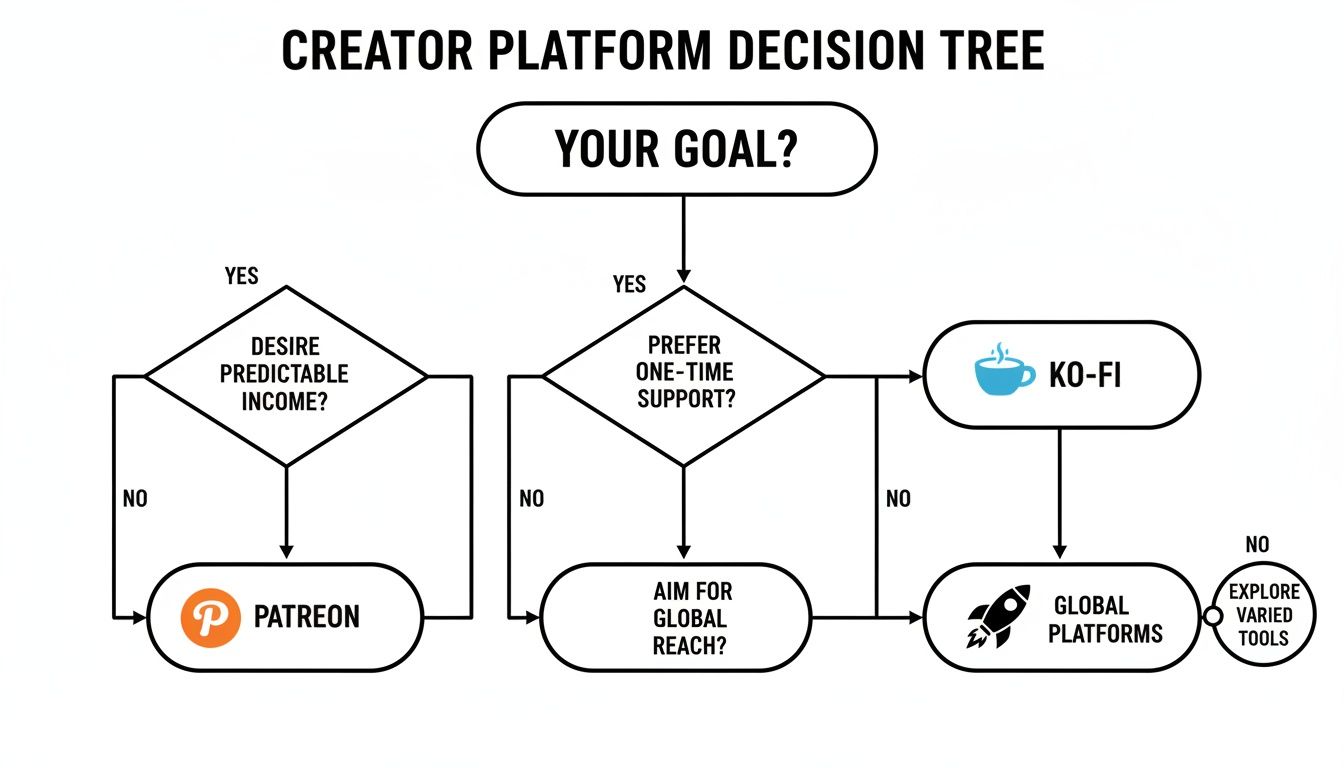
As the chart shows, your decision really boils down to whether your main goal is building recurring revenue or having a flexible way to receive support.
But what happens when you outgrow both? For creators scaling into a full-fledged business with a global audience, a more powerful, dedicated payment solution is often the next step. Simple membership tools just don't cut it when you need to manage complex international payments and access control.
For instance, a platform like Suby is designed for this stage. It automates access management for communities on Discord and Telegram, enabling businesses to sell memberships and digital products worldwide. Everything from payment processing to subscription management is handled in one place, eliminating the manual headaches that come with growth.
While Patreon and Ko-fi are excellent for fan support, it’s smart to diversify. Many successful creators make money from several different channels. For more ideas, check out this guide on generating revenue from YouTube. And if you're weighing other options, you might find our Patreon vs Substack comparison useful, too.
Frequently Asked Questions
Alright, let's tackle some of the common questions that pop up when you're trying to choose between Patreon and Ko-fi. You've seen the features, you know the fees, but a few lingering doubts can hold you back. Let's clear those up.
Can You Use Both Patreon and Ko-fi at the Same Time?
Absolutely. In fact, running both platforms at once is a savvy strategy many creators use to cover all their bases. The trick is to give each platform a clear and distinct job.
Think of it this way: use Patreon for structured, recurring monthly memberships. This is your home for dedicated fans who want exclusive content, behind-the-scenes access, and a deeper connection to your work through tiered rewards.
Meanwhile, you can position Ko-fi as your casual, no-pressure "tip jar." It’s perfect for one-off donations from your wider audience who love what you do but might not be ready for a monthly commitment. This hybrid approach lets you build a reliable income stream while still capturing that spontaneous support from the rest of your community.
Which Platform Is Better for Artists?
This is a question I get all the time, and the honest answer is: it depends entirely on how you want to make money from your art.
Go with Ko-fi if your income comes from a mix of sources like one-off commissions, selling digital goods from your shop, or just getting a "thank you" tip for a piece you shared. The 0% platform fee on donations and straightforward commission tools make it incredibly flexible and financially smart.
Lean towards Patreon if your goal is to build a sustainable business around consistent monthly content. If you're creating tutorials, process videos, or monthly digital art packs, Patreon's powerful tier system and community features are designed specifically for that subscriber-based model.
The bottom line is this: if your income is project-based and tends to fluctuate, Ko-fi’s flexibility is a huge plus. If you're building a predictable, subscription-focused art business, Patreon’s structured environment is tough to beat.
How Do These Platforms Handle International Payments?
Both Patreon and Ko-fi are built for a global audience and will accept payments from supporters almost anywhere in the world. They handle currency conversion on the fly, which is great. However, the reality for creators can be a little messier, with surprise currency exchange fees and frustrating payout delays depending on your bank's location.
As your creative business grows, these international payment hurdles can become a real drag on your revenue and cash flow. This is where you might start looking for a more modern alternative. For example, some payment solutions now offer an API that lets you accept global card or even crypto payments and receive your funds directly as USDC (a stablecoin pegged to the US dollar).
This model completely sidesteps the traditional banking system's delays and expensive FX fees. Your audience pays easily with their card, and you get settled instantly in a stable digital currency. With tools that integrate directly into community platforms like Discord and Telegram, it's a powerful way to manage a paid global community without the usual headaches.
Ready to scale your business beyond the limits of traditional platforms? Suby provides an API that allows any business to accept payments by card or crypto, with instant USDC settlements. Ditch the payout delays and currency fees for good.


