


Think of a crypto payment processor as a universal translator for money. It’s a service that lets businesses accept digital currency, but the best ones do so much more. They create a seamless bridge where customers can pay with their regular credit or debit card, and you, the business, get paid in stable digital dollars like USDC. All of this happens without you ever having to deal with volatile crypto assets yourself.
What Are Crypto Payment Processors
Let's say you're selling a digital product to a customer on the other side of the world. The old way involves a messy chain of banks, painful currency conversions, and a multi-day waiting game before the money actually hits your account. Crypto payment processors were built to cut through all that noise, especially for businesses that live and breathe online.
Instead of piggybacking on slow, expensive banking networks, these processors use modern payment rails to move money across borders quickly. They connect the familiar, everyday world of card payments with the speed and global reach of digital currency.
Bridging Traditional and Digital Payments
At its heart, a crypto payment processor makes global commerce feel local. A customer in Europe can pull out their Visa to buy a subscription from your US-based company, and for them, the experience is no different from any other online purchase.
But behind the curtain, the processor is doing some heavy lifting. It takes the customer's local currency from their card transaction and settles the funds to your business as a stablecoin like USDC. This isn't just a novelty, it comes with some serious perks for merchants:
- Faster Settlement: Forget waiting days for your money. Funds often arrive in a matter of hours, which is a game-changer for cash flow.
- Reduced Cross-Border Fees: You can sidestep the steep currency conversion fees and international wire costs that quietly chip away at your profits.
- Global Reach: Suddenly, you can accept payments from almost anywhere without the headache of setting up foreign bank accounts.
- Predictable Revenue: Getting paid in USDC means your revenue is stable. It's not exposed to the wild price swings of other digital assets.
This model is catching on fast. The market for cryptocurrency payment apps is ballooning as more businesses look for an escape from the bottlenecks of old-school finance. Projections show the market growing from USD 718.26 million in 2026 to USD 2.95 billion by 2035, a pretty clear sign of where e-commerce is headed. You can explore more data on this market growth to see the full picture.
To really grasp the difference, let's compare the old and new side-by-side.
Traditional Payments vs A Modern Crypto Processor
Here’s a quick breakdown of how a modern crypto processor stacks up against the traditional system most of us are used to. The key differences lie in the speed, cost, and global reach of your payment infrastructure.
As you can see, the modern approach cuts out a lot of the middlemen and waiting periods, which translates directly into faster, cheaper, and more reliable payments for your business.
Who Benefits from This Technology
Today's crypto payment processors are built with flexibility in mind. We provide an API that allows any business to accept payments by card or crypto and integrate payments right into its own platform. But it's not just for developers.
For businesses built around communities, we also offer native integrations with platforms like Discord and Telegram to make it incredibly simple to sell subscriptions and manage paid access. This versatility makes these processors a fantastic tool for SaaS companies, online creators, and e-commerce stores that want to scale internationally without all the friction.
How Modern Processors Bridge Cards and Crypto
Connecting a familiar Visa or Mastercard payment to a digital wallet full of stablecoins might sound complicated, but modern crypto payment processors have engineered it into a surprisingly straightforward, three-step journey that happens behind the scenes. Once you see how it works, it becomes clear how this technology sidesteps the usual headaches of cross-border payments.
The entire process is built for simplicity. Your customer's checkout experience doesn't change one bit, they just use their card as they always do. But for your business, the result is a game-changer: predictable, stable revenue that arrives quickly and efficiently.
This diagram shows the direct path from your customer's card to USDC landing in your business wallet.
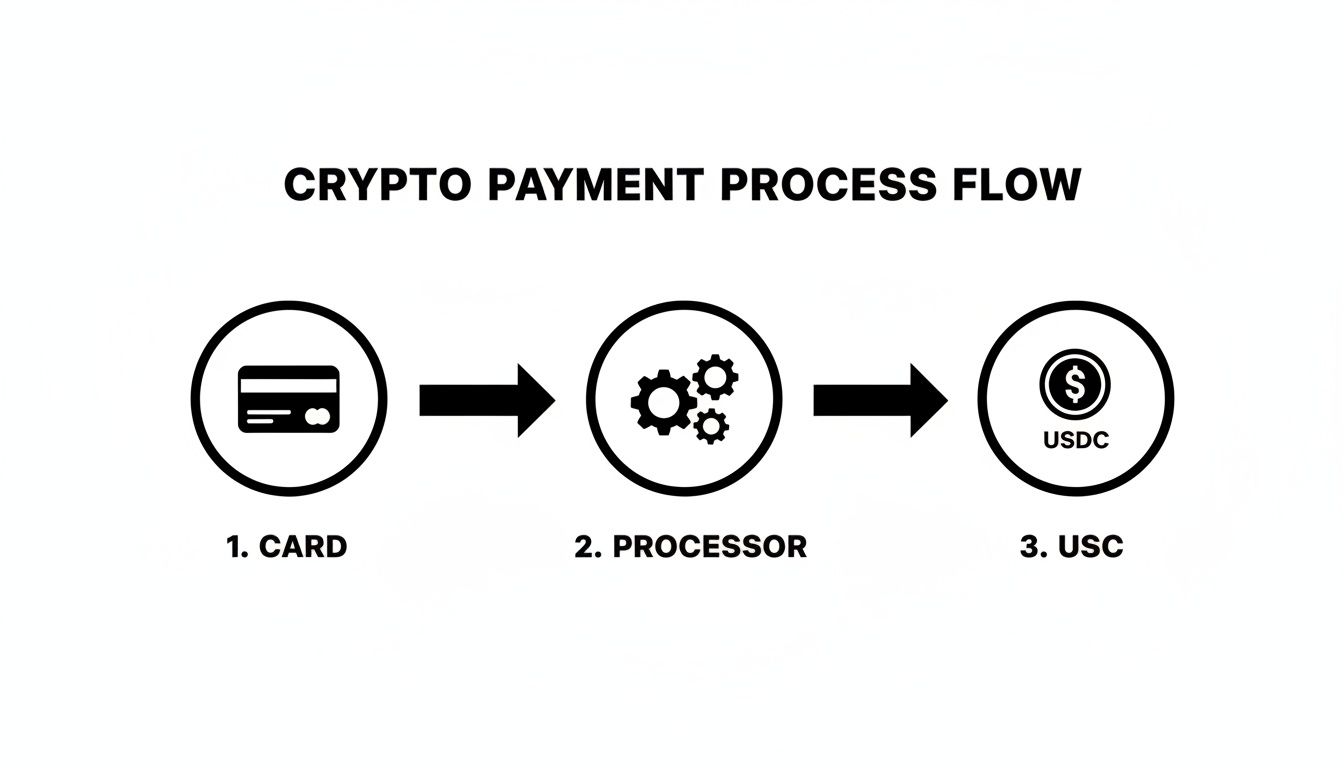
The key takeaway here is the removal of the slow, expensive banking middlemen, creating a direct line to your funds.
Stage 1: The Payment Rails
It all starts on what we call payment rails. Think of these as the financial highways that money travels on. When a customer types in their card details, a modern processor uses the same secure, well-established rails as any big e-commerce site. This is crucial because it means the customer's experience feels completely normal, and no crypto knowledge or extra steps are needed.
In the background, the processor is doing all the heavy lifting, running the security checks, getting the necessary authorizations, and making sure the funds are good. It’s exactly what a traditional payment gateway does. The magic is in what happens next.
Stage 2: Settlement and Conversion
This is where a crypto payment processor really shows its strength. Instead of sending that payment on a slow, winding journey through a web of international banks, a trip that can take days and rack up fees at every stop, the processor converts the funds to USDC almost instantly.
The moment the card payment is approved, the money is converted into USDC and settled directly into your business’s digital wallet. For a global business, this has a few massive advantages:
- Speed: Settlement happens in hours, not days. This is a huge boost for cash flow, giving you access to your revenue when you need it.
- Stability: By settling in USDC, a stablecoin pegged to the US dollar, you're shielded from the price swings of other cryptocurrencies. One USDC is designed to always be worth one dollar.
- Accessibility: Your money lands in a wallet that you control. You can access it from anywhere in the world, without the need to open a traditional bank account in that specific region.
This direct-to-wallet settlement model is what allows businesses to completely bypass the slow and costly SWIFT system, which has been a major bottleneck for international commerce for decades.
This whole conversion is completely invisible to you and your customer. They pay in their local currency, and you receive a stable, digital dollar amount. It creates a clean, predictable financial operation. If you’re tired of juggling multiple currency accounts and dealing with unpredictable exchange rates, this is a major operational upgrade.
Stage 3: Simplified Fees
The final piece of the puzzle is the fee structure. Traditional payment systems are famous for their confusing and often hidden costs. You get quoted a nice low rate, but the final bill is almost always higher thanks to a bunch of extra charges that magically appear on your statement.
These nasty little surprises often include:
- Currency Conversion Fees: A hefty markup tacked on when converting your customer's currency to yours.
- Cross-Border Charges: An extra percentage charged just because the payment came from another country.
- Payout Fees: Costs for the simple act of moving your own money from the processor to your bank account.
A modern crypto payment processor cuts through all that noise. We use a single, all-inclusive fee that covers the entire transaction, from card swipe to settlement. This transparency means you know your exact cost per sale, making your financial forecasting far more accurate.
With an API-driven solution like Suby, businesses can integrate this streamlined payment flow directly into their platforms to handle everything from one-time purchases to recurring subscriptions. We also offer native integrations for Discord and Telegram, which is perfect for creators and communities running paid groups. In the end, the model is always the same: your customers pay with their cards, and your business gets paid in USDC.
How to Pick the Right Crypto Payment Processor
Choosing a partner to handle your payments is one of the most important decisions you'll make. It’s not just about moving money, it’s about trust, security, and your customer’s experience. And with the crypto payments market expected to hit USD 4,240.80 billion by 2034, getting this right is more crucial than ever.
So, what's driving this massive shift? Businesses are realizing they can cut costs, tighten security, and send money across borders instantly. Much of this growth is powered by stablecoins like USDC, which give businesses the benefits of digital currency without the wild price swings. The trend is clear: more and more companies are looking for a better way to get paid.
When you start looking at crypto payment processors, it's easy to get fixated on transaction fees. But that’s only one piece of the puzzle. You need a partner that fits your business like a glove, one that meets your security standards, integrates smoothly with your current setup, and can support you as you grow. The goal is to find a solution that lets your customers pay easily with their cards while you receive stable USDC revenue.
This boils down to three core areas you absolutely have to nail down.
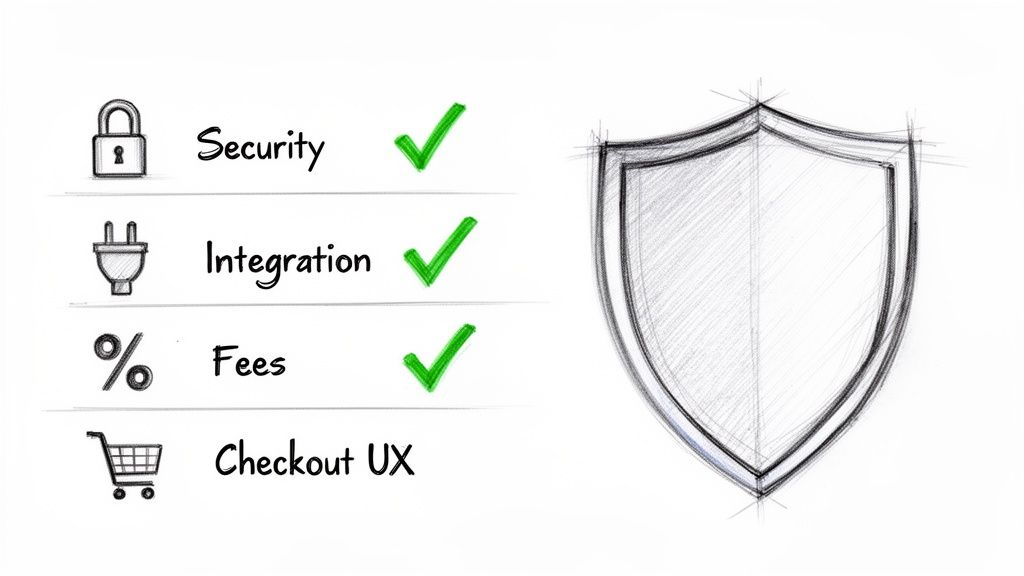
Think of these as the non-negotiables: rock-solid security, flexible integration, and a fee structure you can actually understand.
Security and Compliance Are Non-Negotiable
Let's be blunt: security is everything. When a customer types their card details into your checkout form, they're placing their trust in you. A breach doesn't just cost money, it shatters that trust. That's why the first thing you should look for is PCI-DSS certification. It’s the industry gold standard, ensuring a processor handles sensitive card data with bank-grade security.
This isn't just about ticking a box. It protects you and your customers from the very real threats of fraud and data theft. A great processor goes even further, offering features like two-factor authentication (2FA) and Strong Customer Authentication (SCA) to lock things down. A secure checkout isn't just a feature, it’s what brings customers back.
Flexible Integration Options for Growth
Your business isn't a cookie-cutter template, so your payment system shouldn't be either. The right processor gives you options that can scale right alongside your ambitions.
- Payment Links: Perfect for freelancers, agencies, or anyone who just needs to get a one-off invoice paid. Simply create a link, share it, and you're done.
- Embedded Checkout: If you run an e-commerce store or a SaaS platform, you need a checkout that feels like a natural part of your site. An embedded form keeps customers on your page, which is a proven way to reduce cart abandonment and boost conversions.
- Full API Integration: For businesses with unique workflows or custom platforms, a powerful API is essential. We provide an API that allows any business to accept payments by card or crypto. It gives your developers the keys to build whatever you need, from custom payment flows and recurring billing to webhooks that sync payment data across all your systems.
We also offer native integrations for platforms like Discord and Telegram, making it incredibly simple for community owners to manage subscriptions and paid access without writing a single line of code.
The Customer Experience and USDC Settlement
All the fancy tech in the world doesn't matter if the checkout experience is confusing for your customer. The ideal payment flow should be completely familiar: they enter their card details, click "Pay," and that's it. They shouldn’t have to know what a digital wallet comparison is, let alone own one.
This is exactly why the "card-to-USDC" model works so well. It keeps the front-end experience simple and frictionless for your customers, removing any barrier to payment. On the back end, your business gets its funds settled in a stable, globally accessible digital currency. It's the best of both worlds.
Ultimately, choosing the right partner is about finding a solution that makes your life easier while opening up new doors for your business.
Alright, let's move from the "what" to the "how." Knowing how crypto payment processors work is one thing, but actually putting one to work for your business is what really matters.
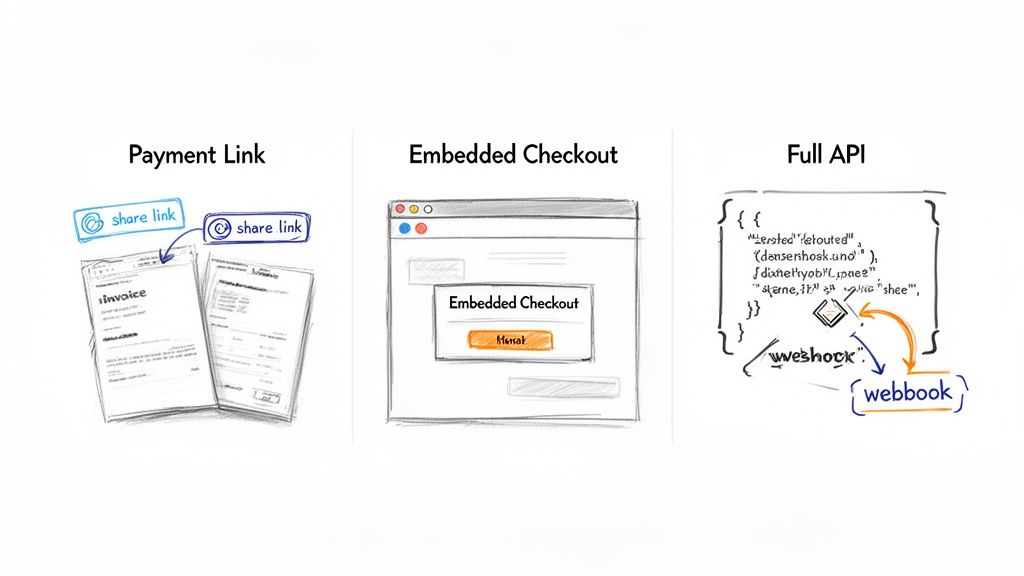
The good news is that you have options, and they range from incredibly simple to deeply customizable. The right path for you really boils down to your business model, your technical comfort level, and how your customers buy from you. No matter which you choose, the goal is the same: give your customers a familiar card checkout experience while your business gets the speed and stability of USDC settlements.
Let's break down the most common ways to get this set up.
Payment Links: The No-Code Starting Point
If you’re a freelancer, consultant, or run an agency, Payment Links are your new best friend. This is the fastest, simplest way to get paid from anywhere in the world, with zero coding required.
You just generate a unique link for a product or service and send it to your client, over email, Slack, WhatsApp, you name it. They click the link, pay with their card like they would anywhere else, and you receive the funds as USDC in your wallet. For one-off projects and invoices, it completely sidesteps the delays and fees of traditional bank wires. It just works.
Embedded Checkout: Keep Customers on Your Site
For e-commerce sites and SaaS companies, keeping a customer on your website during checkout is everything. Every redirect is a chance for them to get distracted and abandon their cart.
An Embedded Checkout solves this by letting you drop a payment form directly onto your own site. It looks and feels like it’s part of your brand, creating a trustworthy and seamless experience. Your customer never leaves your domain, but you still get the powerful payment engine doing all the heavy lifting in the background. It's the perfect blend of professional polish and powerful functionality for both one-time sales and recurring subscriptions.
Full API Integration: For Total Customization
What if your business has a truly unique sales flow or a complex backend system? That’s where a full API integration comes in. Our API allows any business to accept payments by card or crypto, giving developers the keys to build completely custom payment experiences.
This isn't just about the checkout form. With webhooks, your system gets real-time pings about every payment event, such as a successful charge, a renewed subscription, or a failed payment. This lets you automate everything. Think: instantly granting access to a digital product, updating a user’s account status, or kicking off a sequence for a failed charge. It’s about making your entire revenue operation run on autopilot. When it comes to managing payouts, whether for contractors or partners, a good API provides the flexibility needed for effective strategies for paying them on time.
Native Integrations: Monetize Your Community
Business doesn't just happen on websites anymore. For creators and community managers running paid groups on platforms like Discord or Telegram, native integrations are a game-changer.
Instead of manually tracking payments and adding or removing members, these integrations handle it all for you.
- Automated Role Management: A new subscriber automatically gets their "VIP" role in Discord or an invite to your private Telegram channel.
- Access Control: If their payment fails or their subscription ends, their access is just as quickly and automatically revoked.
This lets you stop being an administrator and focus on what you do best: creating great content and engaging with your members. It transforms your community into a scalable, self-sustaining business. If this sounds like what you need, our guide on how to accept international payments dives deeper into setting this up.
Why This Matters for Internet-Native Businesses
If your business was born on the internet, you're global by default. But the old-school financial world? It wasn't built for that. It’s a messy web of regional banks, slow-moving wire transfers, and small fees that create drag on your growth. A modern crypto payment processor cuts right through that mess.
The real game-changer is having a single, unified financial rail for your entire business. Instead of trying to patch together different payment gateways for different countries or opening foreign bank accounts, you get one clean system. Suddenly, selling a subscription in Singapore or invoicing a client in Germany becomes just as easy as a local transaction.
Your customers still pay with their card, the way they always have. But on your end, the money lands directly in your business wallet as USDC. This gives you a stable, predictable revenue stream that’s accessible anywhere in the world.
Escaping Cross-Border Complexity
For any business operating internationally, currency conversion and settlement delays are the two biggest headaches. Traditional banking can leave your money in limbo for days, and by the time it lands, hidden fees and bad exchange rates have already taken their bite.
A crypto payment processor that settles in USDC is designed to fix this from the ground up.
- No Surprise FX Fees: You receive payments in a stablecoin pegged to the US dollar. This lets you completely sidestep the wild swings and high costs of currency conversion. What you charge is what you get.
- Settlement in Hours, Not Days: Forget waiting the typical two to seven business days for your money. Payments clear incredibly fast, giving your cash flow a serious boost and putting your revenue to work immediately.
- Global Reach from Day One: You can accept payments from anywhere without needing a local bank account in every single country. This just erases a huge administrative and financial barrier to growing your business.
This streamlined model is a big reason why the global crypto payment gateway market is projected to jump from USD 50.10 billion in 2026 to USD 206.81 billion by 2033. Businesses are catching on fast, looking for ways to cut out the delays and costs that come with traditional cross-border e-commerce.
Simplifying Your Operations
Beyond just moving money, the right solution can dramatically reduce your software costs and administrative burden. For any SaaS founder or digital creator, operational efficiency is just as crucial as revenue.
Instead of connecting different tools together for billing, subscriptions, and even community access, you can run everything from a single, integrated platform. For instance, a robust API and native integrations let you manage your entire customer lifecycle from one dashboard.
A unified system means you can handle one-time payments, set up recurring subscriptions, and even automate access to a Discord or Telegram community, all through one provider. This is a massive improvement over the disjointed, multi-tool setups most online businesses are stuck with.
Consolidating your tools doesn't just save you money on software subscriptions, it saves you a ton of time. You're no longer manually syncing customer data between different systems or wrestling with the technical debt of maintaining a dozen integrations. If you're serious about scaling, simplifying your tech stack is one of the smartest moves you can make. You can dig deeper into this idea in our guide on how a merchant of record can simplify global sales.
Answering Your Key Questions
Whenever you're thinking about changing how you get paid, a few questions naturally pop up. Moving to a modern crypto payment processor is a big decision, so let's walk through the most common things merchants ask before they jump in.
Most business owners start by worrying about their customers. The good news? For your clients, the checkout experience doesn't change one bit. It feels just like any other online purchase they make every day.
Do My Customers Need Crypto to Pay?
Not at all. This is probably the biggest misconception out there, but the whole point of this model is to keep things simple for the person buying from you. Your customers will see a standard checkout form where they can pull out their Visa or Mastercard and pay as they always do.
All the magic happens behind the scenes. The payment processor takes their local currency from the card payment, handles the conversion, and settles it as USDC for you. From your customer's perspective, nothing is different, which keeps the sales process smooth and familiar.
Is Receiving and Managing USDC Difficult?
Definitely not. If you can handle a regular bank account, you’ll have no trouble with a digital wallet. Setting one up is fast and straightforward, and once it’s ready, it essentially becomes your international account for receiving payments.
Think of it as a bank account, but without the borders, the high fees, or the frustrating delays. You get instant, 24/7 access to your revenue from anywhere on the planet. This whole setup cuts out the usual headaches of international banking and puts you back in control of your own money.
The core idea here is simple: you should own and have immediate access to your funds. Traditional systems can hold your money for days, but USDC settlements land directly in your wallet. This dramatically improves your cash flow and gives you more freedom to run your business.
That direct access is a huge departure from waiting around for slow, multi-day payouts to finally clear.
How Do the Fees Compare to Traditional Gateways?
This is where the advantages really start to stack up. Modern crypto payment processors usually have a single, transparent fee for every transaction. That one percentage covers everything, from processing the credit card payment to settling the final USDC in your wallet.
It’s a world away from the old-school payment gateways. They might advertise a low rate upfront, but then they hit you with a long list of extra charges, like:
- Currency conversion markups that quietly eat into your revenue.
- Cross-border charges that penalize you for selling internationally.
- Payout fees you have to pay just to access your own money.
When you bundle everything into one clear rate, your costs become predictable. For businesses selling globally, this often means paying significantly less in total fees and finally putting an end to those surprise deductions from your bottom line.
Ready to simplify your global payments? Suby offers a complete solution that lets your customers pay by card while you receive stable USDC. Get started with Suby today and unlock faster, more predictable revenue for your business.


